A supply chain is the chain of hands a product passes through between raw material and your front door. Mine, grow, refine, make, ship, clear customs, deliver. Each link adds cost, each link can fail, and no single company controls the whole thing.
This article follows one generic product, a cotton T-shirt, along that path. The route is typical of most consumer goods, and once you have seen it once, you can map almost anything else onto it: the coffee maker, the phone charger, the bicycle.
What does "supply" actually mean in the chain?
Start with the word itself. According to Corporate Finance Institute, supply is the number of units of goods or services a supplier is willing and able to bring to market at a specific price. That willingness matters. A factory can produce a million shirts, but if the price buyers will pay does not cover the cost of making them, the supply that reaches the market is zero.
Price and time are part of the definition. CFI's explainer uses a farmer selling crates of tomatoes to make the point: twenty crates a month at one price is a different supply decision than forty crates at a higher price. The same logic runs through every link of a supply chain. Each participant, from cotton farmer to freight line to retailer, is answering the same question: at this price, how much am I willing to move, and how fast?
That is also why a supply chain is a chain of incentives, not just a chain of trucks. Nobody in it works for free, and every delay or shortage somewhere upstream is usually someone, somewhere, deciding the price no longer justifies the effort.
Step one: the raw material leaves the farm
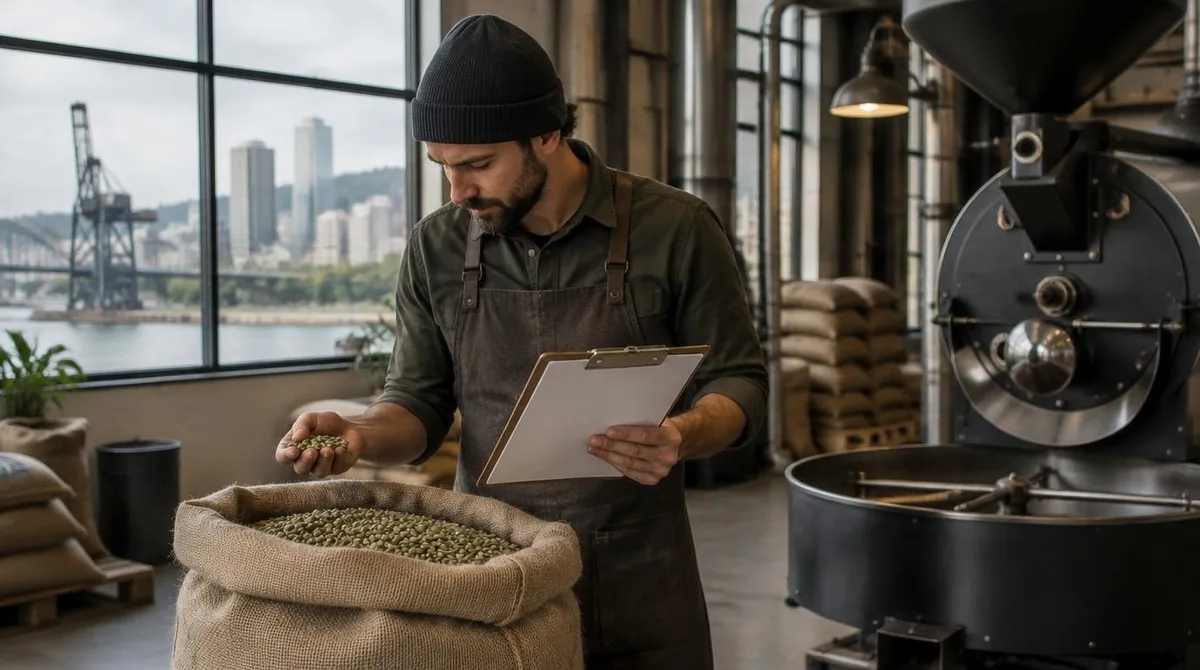
Our T-shirt begins as cotton bolls on a farm, possibly thousands of miles from where the shirt will be sewn. The cotton is picked, ginned to separate fibre from seed, and pressed into dense bales. At this stage the product is a commodity. One bale is much like another, and price is set by global markets rather than by any single farmer.
Commodities are the quiet foundation of every supply chain. Because they are interchangeable, they trade on price alone, and they move in bulk, by the shipload and the trainload. The economics here are unforgiving: a farmer's cost of production does not fall when the market price does, which is why raw-material producers are often the most exposed link in the chain when demand turns down.
There is also a coupling most shoppers never think about. CFI describes this as joint supply: producing one good automatically produces another. The classic example is lamb, where farming lambs yields both meat and wool, so a decision to reduce lamb farming cuts the supply of both. Cotton has cousins too, in the form of cottonseed oil and feed, meaning a decision on one commodity shelf quietly ripples into others.
Step two: spinning, sewing and the factory floor
The bales travel to a spinning mill, which turns fibre into yarn. The yarn moves again, to a cut-and-sew factory, where fabric is knitted or woven, dyed, cut into panels and stitched into shirts. Each of these steps is often a separate company, in a separate country, with its own suppliers, wages and energy costs.
This fragmentation is deliberate. Splitting production across specialised firms keeps each step competitive, and it lets a brand switch suppliers without rebuilding a factory. The trade-off is coordination risk. The brand may own the design and the label, but it owns none of the machines. When a dye house misses a deadline, the delay propagates downstream through no fault of the sewing line.
For a small business buying or selling in this world, the paperwork matters as much as the product. Codes that classify goods, origin certificates and delivery terms all determine who pays which cost at which border, and getting them wrong is expensive. Our guides on how HS codes decide what your shipment costs and which Incoterm a first-time exporter should choose cover those mechanics in detail.
Step three: the ocean crossing
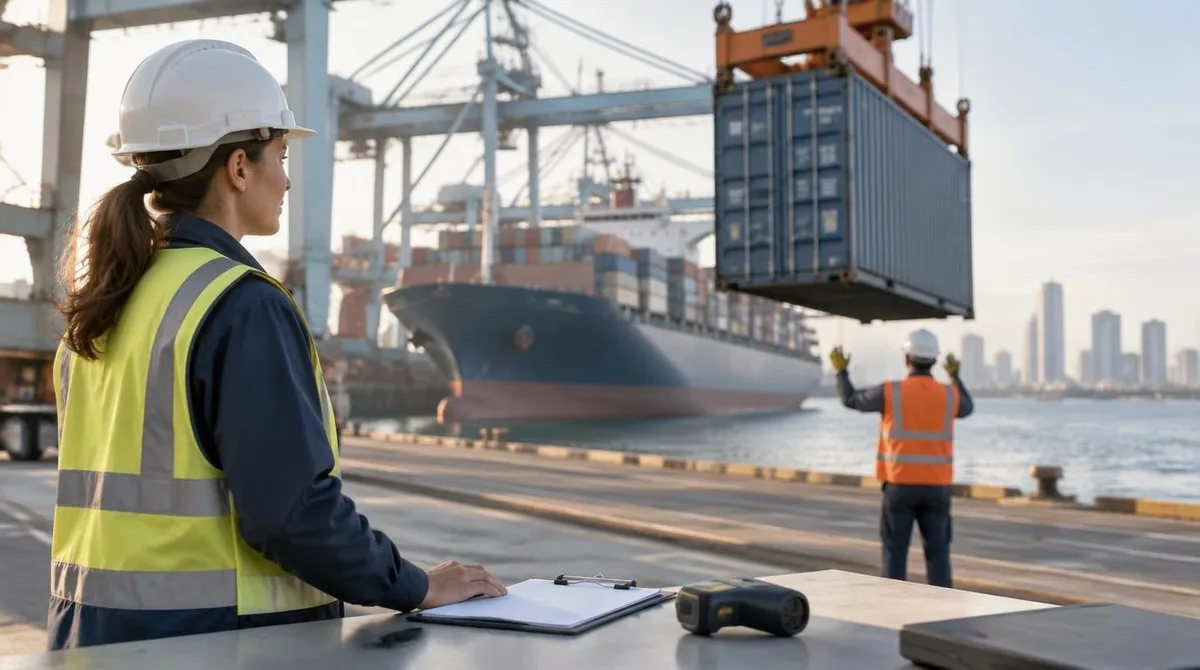
Finished shirts are packed into cartons, the cartons into a container, and the container onto a ship. This is the least visible and most consequential leg. A modern container vessel carries thousands of steel boxes, and the schedule a ship keeps is the heartbeat of global retail: merchandise is planned around sailing dates months in advance.
What happens at sea is mostly a waiting game governed by ports. We have covered the machinery of ports and global shipping elsewhere; the short version is that a container's journey is a sequence of queues, at the berth, at the crane, at the yard, at the gate. Each queue has a price attached when it runs long.
That price is why freight costs move the way they do. Ocean freight rates swing because capacity is fixed in the short run while demand is not, and because the route a ship takes can be rerouted, slowed or shortened by events far from the destination port. A retailer who budgeted one freight number in spring may pay several times that by autumn, for the identical box.
Step four: customs, the warehouse and the last mile
When the container lands, it is not yet yours or the retailer's. It enters a customs process: declaration, classification, duty assessment and, sometimes, inspection. Only after clearance does the container move to a warehouse, where cartons are broken down, sorted and shipped onward to stores or to individual buyers.
The last mile, the final delivery to a doorstep, is paradoxically the most expensive segment per item. Moving one container across an ocean is efficient; moving one shirt across a city is not. The whole retail model, from free-shipping thresholds to store networks, is an attempt to manage that last-mile cost.
For importers, the border is also where policy bites. Tariff schedules, exemption thresholds and documentation rules change, and each change lands directly on the landed cost of the goods. Our coverage of what small importers owe after the de minimis exemption ended is one recent example of a rule change rewriting that arithmetic.
Why supply chains break, and who pays
Breakage has a pattern. The most common cause is a mismatch between price and willingness to supply, the definition we started with. When the price offered for a good falls below what suppliers find worthwhile, supply dries up, quietly and legally. Shortages are often price signals wearing a costume.
The second cause is rigidity. CFI's account of supply elasticity, how much quantity responds when price changes, applies at every link. Some links are elastic: a sewing factory can add shifts. Others are not: a new container ship takes years to build, a new port takes longer. When demand shifts quickly against an inelastic link, the queue forms there, and the cost of the queue, in freight rates, in delays, in empty shelves, is passed downstream.
Who ultimately pays? Everyone, in different quarters. The factory absorbs it in lost margin, the retailer in markdowns and stockouts, the shopper in price or in waiting. The distribution of that pain is a business decision made at contract time, which is why delivery terms and who-pays-what clauses deserve more attention from small firms than they usually get. This connects to our earlier piece, Which Incoterm Should a First-Time Exporter Choose.
What this means for owners and buyers
Our analysis of the arc above is simple: a supply chain is not infrastructure, it is a set of contracts between parties with different costs, different time horizons and different information. The shirt reached your door because every party along the way, at that moment, at that price, preferred to keep the chain moving rather than stop.
For a small business, that suggests three practical habits. Know which links in your own chain are inelastic, because those are where your delays will concentrate. Price your contracts with the queue in mind, not just the freight rate. And remember that every supplier is a price-taker somewhere upstream, so a change you see in your costs usually began as a change someone else felt first.
For everyone else, the lesson is humbler. The ordinary T-shirt is a negotiated settlement among farmers, mills, factories, shipping lines, customs officers and couriers, renewed with every order. It arrives not because the system is smooth, but because enough people, enough of the time, find it worth their while.