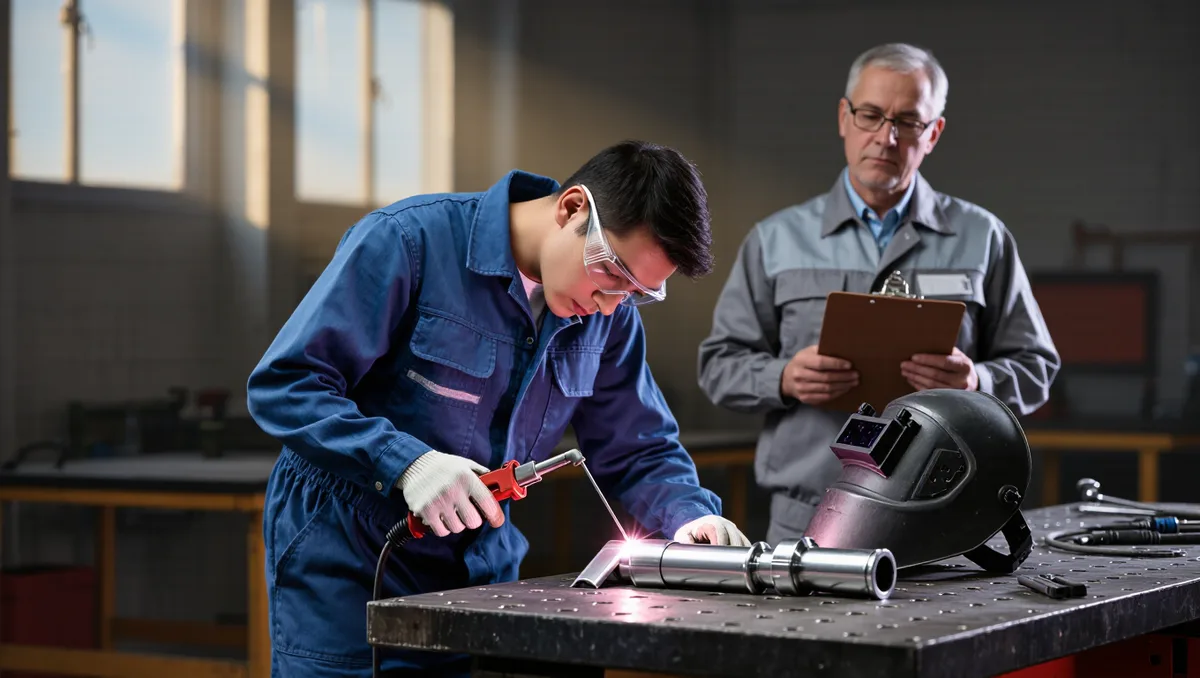
A trade up challenge is a skills contest built on a simple idea: prove you can do the work, one task at a time. Instead of sitting an exam, a contestant welds a joint, wires a panel, or cuts a joint in wood, and a judge checks the result against a standard. Move up, or go back and practice.
The format borrows from the oldest training system in the skilled trades — the apprenticeship — where a beginner learns under a journeyman, then earns the right to be called a master. What the challenge version adds is pressure and visibility. It compresses years of progression into a series of short, judged tasks, and it shows something written tests rarely can: whether hands can do what the brain claims to know. This connects to our earlier piece, Trade Jobs Explained: Why Skilled Trades Are Booming.
What exactly is a trade up challenge?
Think of it as a ladder of tasks. Each rung is one defined piece of trade work — a single weld, a single plumbing repair, a single electrical circuit — with clear rules and a clear pass mark. Contestants start at the apprentice level. If the work meets the standard, they advance to the next rung, which is harder and less forgiving.
The details vary by trade and by organizer, but most versions share three features. First, the task is real, not theoretical. Second, the judging is based on the finished work, not on confidence or charisma. Third, failure is part of the design: a contestant who botches a task usually gets a chance to correct it or to return after more practice. That mirrors how trades actually develop people — repetition under supervision, then independence.
How does the apprentice-to-master path actually work?
The traditional path has three broad stages, and the challenge format maps onto each one.
- Apprentice. The beginner works under supervision. The goal is safe habits and correct technique, not speed. In a challenge, this is the stage where judges watch form: how a contestant holds the tool, sets up the work, and follows the safety steps.
- Journeyman. The worker can complete standard jobs alone. The test shifts from technique to judgment — reading the job, choosing the right method, dealing with the surprise behind the wall or under the hood.
- Master. The worker can handle the hardest cases and, often, teach others. In a challenge setting, this shows up as consistency: the same clean result under time pressure, again and again.
The useful insight is that each stage is judged by different evidence. An apprentice is judged on process. A journeyman is judged on outcomes. A master is judged on whether the outcomes hold up when conditions turn against them. A well-built trade up challenge tests all three, in that order.
What do these challenges reveal about hands-on learning?
They reveal the gap between knowing and doing. Many people can describe how a task should be done. Fewer can do it to standard on the first attempt, and fewer still can do it when someone is watching the clock. A skills challenge makes that gap visible in a way a résumé never does.
It also reveals the value of small, well-defined tasks. Breaking a trade into single, judgeable units does two things for a learner. It makes feedback immediate — you know within minutes whether the weld passed. And it makes progress measurable — you can see exactly which rung you reached and which one beat you. That is hard to get from a semester of coursework, where feedback often arrives weeks after the work.
There is a third lesson, and it is the one employers tend to care about: composure. Hands-on challenges put a beginner under observation, which is uncomfortable. Learning to work well while someone watches is itself a trade skill. Customers watch too.
Why do competition formats work so well for skills?
Public competition has become a proven way to make any skill watchable. According to Wikipedia, the Sidemen's reality competition series Inside, first released in 2024, built its format around contestants competing in challenges for a £1 million prize fund — with every purchase or failure costing them money from that fund. The mechanics differ from a trade contest, but the underlying draw is the same: a defined task, real stakes, and a visible standard of success or failure.
For skills training, that visibility is not just entertainment. When a contest is public, the standard becomes shared. Spectators learn what good work looks like. Employers see candidates perform under pressure. And contestants get something a private classroom rarely offers — a reason to practice until the work is genuinely right, not merely submitted.
What this means for owners and career changers
For a small business owner in a trade, the challenge format is a hiring tool hiding in plain sight. Instead of sorting applicants by credentials alone, set a short practical task and judge the result. A fifteen-minute task at the bench tells you more about a future employee than an hour of conversation. It also signals to candidates what the job actually is.
For someone considering a skilled trade, the lesson is about how to choose a training path. Look for programs built around judged, hands-on work with quick feedback, and be wary of any path that never asks you to produce the thing. The apprentice-to-master ladder is slow by design, and that slowness is the point: competence in a trade is built from hundreds of small, checked tasks, not from one big test at the end.
The evidence behind skilled-trades demand, and what it pays, is covered in our guide to why skilled trades are booming and our rundown of the highest paying trades that skip the four-year degree.
The trade up challenge, in the end, is not a gimmick. It is the apprenticeship model wearing a scoreboard. It asks the question every employer and every customer eventually asks — can you actually do the work? — and it makes the answer something everyone can see.