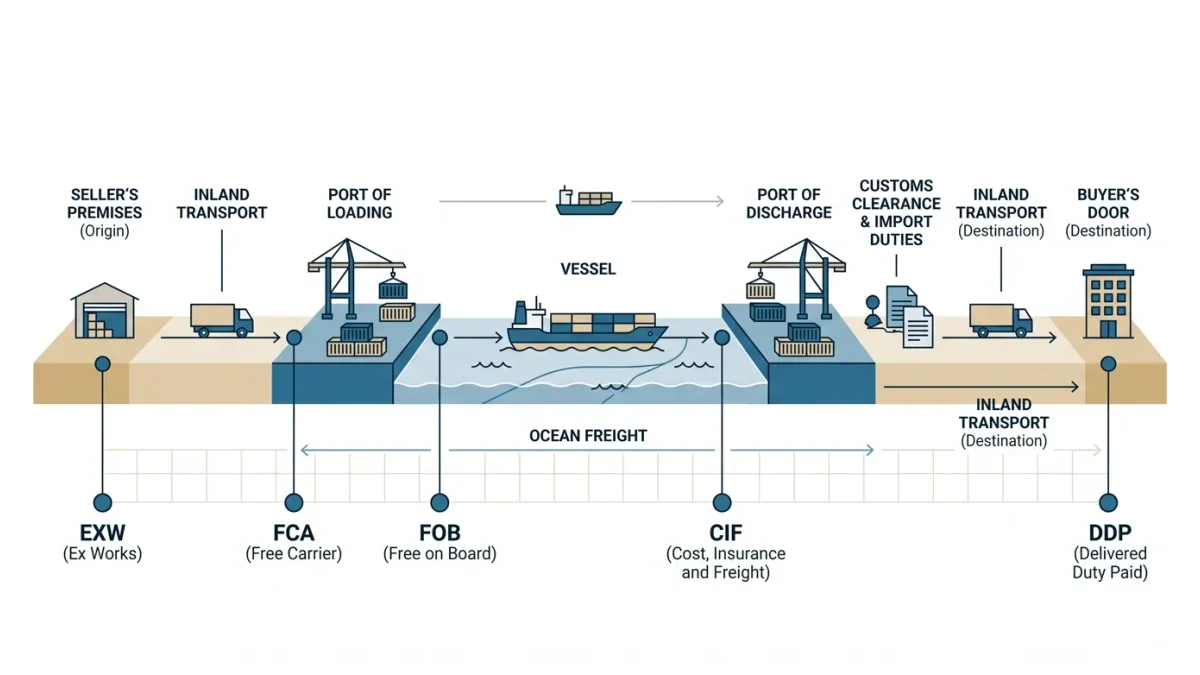
First-time exporters should generally start with terms that keep responsibility close to home — EXW or FCA when selling, and CIF for simple ocean shipments to willing buyers — before graduating to D-terms that make the seller responsible deep inside a foreign country. Incoterms, the International Chamber of Commerce's trade terms published in their current 2020 edition, define the exact point where cost and risk transfer from seller to buyer in every shipment; choosing one is deciding who pays for what and, more importantly, who bears the loss if goods are damaged, delayed, or lost. New exporters regularly lose money not on price but on terms they did not understand they had accepted. This article explains the map.
What Do the Terms Actually Divide?
Every Incoterm answers the same three questions along the journey: who arranges and pays transport for each leg, who bears risk of loss at each point, and who handles export and import customs clearance. The eleven Incoterms 2020 rules range across that journey. EXW (Ex Works) makes the buyer responsible from the seller's loading dock — including export clearance, which in practice makes EXW awkward for U.S. exports because exporters, not buyers, file export declarations. FCA (Free Carrier) hands risk to the buyer at a named delivery point with the seller handling export clearance, and is the ICC's recommended term where the old FOB was misused for containers. C-terms (CPT, CIF, CIP) have the seller pay for carriage but — the classic trap — risk transfers at origin, not destination: the seller buys the freight but not the safety. D-terms (DAP, DPU, DDP) push seller responsibility to the destination, with DDP the heaviest, including foreign import duties the seller usually cannot competently pay.
What Are the Ocean-Only Terms?
Four terms apply only to sea and inland waterway transport: FAS, FOB, CFR, and CIF. They still fit bulk and non-containerized cargo, but for containerized freight the risk-transfer point of FOB — goods pass the ship's rail — no longer matches physical reality, because containers are handed to the terminal days before loading. That mismatch is why the ICC steers container shippers to FCA instead. CIF (Cost, Insurance and Freight) remains a common first-timer's term for ocean sales: the seller pays freight and minimum marine insurance to the destination port, risk transfers on loading, and the buyer takes over at arrival. CIF's insurance default is the minimum Institute Cargo Clauses coverage; CIP — its multimodal sibling — now requires a higher insurance level under Incoterms 2020, a distinction worth knowing when comparing quotes.
What Should a New Exporter Actually Do?
- Start with FCA on the export side: you control export clearance and hand risk to the buyer at a defined U.S. point, keeping complexity low.
- Use CIF for straightforward ocean deals where the buyer prefers you arrange carriage — you keep the freight margin and the relationship, without destination responsibility.
- Avoid DDP until you have import expertise in the destination country; mis-declared duties and taxes land on the seller.
- Never quote EXW as a favor: buyers' carriers at your dock, export filings you cannot sign, and risk on your premises from the moment of "availability" — EXW helps the buyer, not you.
- Match terms to payment: under letters of credit, the term, the documents, and the delivery point must agree exactly, or the bank will not pay.
Where Do New Exporters Get Burned?
Three patterns recur. Selling CIF and believing risk transfers at destination — it transfers at loading, so uninsured-in-transit means uninsured by the buyer's choice. Accepting DDP to close a deal and discovering destination duties, VAT, and brokerage the margin never covered. And quoting one term while the purchase order says another: the contract governs, and "FOB" in a buyer's template can mean freight terms that have nothing to do with Incoterms at all. The lesson: the Incoterm is where the price's real risk lives — choose it as deliberately as the number.