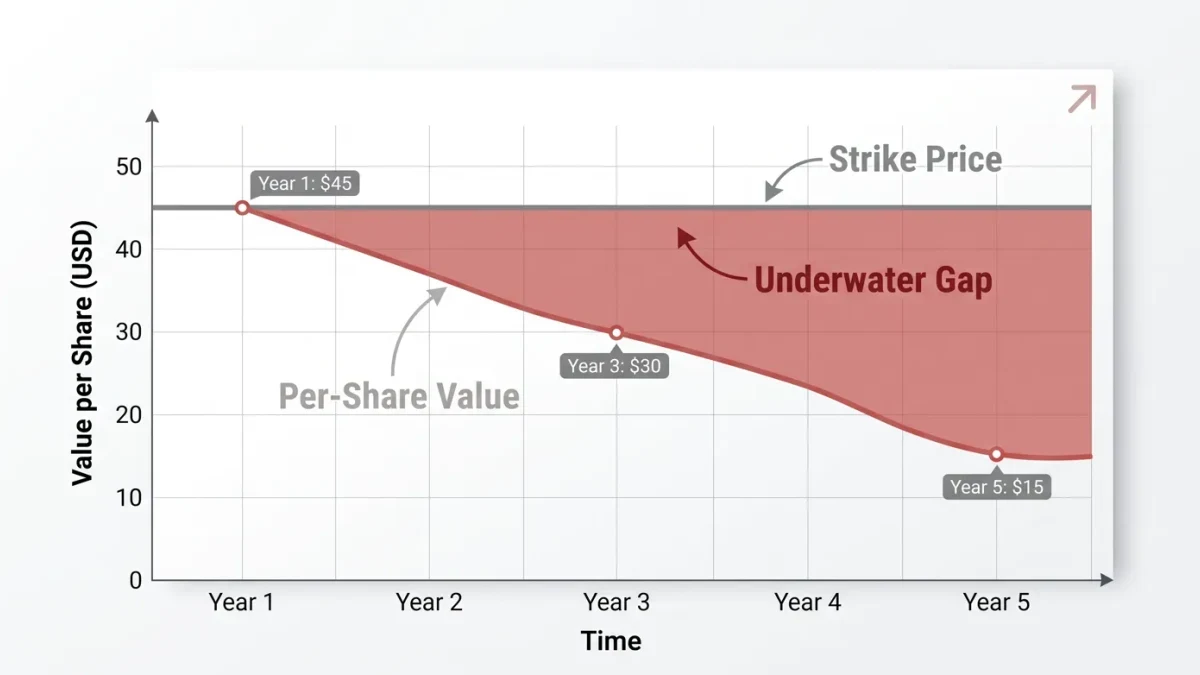
A down round — priced financing at a valuation below the previous round — cuts employee option value three ways: existing strikes stay fixed while share value falls, leaving options underwater; the 409A fair-market-value mark that sets new grant prices drops, repricing the whole equity currency downward; and heavy new-investor terms, including anti-dilution adjustments and liquidation preferences, can reduce what common shares receive in an exit below what employees expected. For staff holding options in a company that just raised down, the arithmetic and the recovery options both matter, because an underwater option is not worthless — it is a bet on the recovery path with a reset entry price. This article explains the mechanics from the employee's side.
Why Do Options Go Underwater?
A stock option's value is the spread between the strike price — fixed at grant, set at the then-current 409A fair market value — and the share's actual worth. When the preferred price falls from, say, $10 to $5, options granted at strikes near $10 are underwater: exercising buys shares for more than they are worth. The practical consequences are sequential. New grants reprice automatically, because the company's independent 409A valuation resets, so new hires receive lower strikes than employees who joined earlier at the peak — a morale inversion familiar to anyone who lived through 2022-2023 or 2008. And the company's retention economics break: equity that stops being a motivating asset pushes exactly the people it was meant to retain toward the door.
What Do Liquidation Preferences Have to Do With It?
Down rounds frequently bring new money in ahead of the common stock: liquidation preferences — the investors' right to take their money (sometimes a multiple, sometimes with participation) off the top in a sale — stack. A company that raised $100 million across rounds and sells for $110 million may return little to nothing to common shareholders after preferences, even though headline valuations once implied riches. This is the arithmetic employees should run before weighing any offer or retention grant: the exit math is waterfall math, and preferences from a down round sit in the waterfall ahead of employee shares. Companies are not required to disclose the full preference stack, but candidates can and should ask for it — the cap table's total preference is a fair question in any negotiation.
What Are Reprisings and Refresh Grants?
Boards respond to underwater equity in two ways. A repricing amends existing option strikes to the current lower 409A value — often with vesting resets or conditions attached, and under accounting rules requiring expense re-measurement that boards dislike, which is why repricings cluster in severe downturns. More common are refresh grants: leaving old options alone and granting new ones at the low strike, layered on additional vesting. Employees comparing the two should note the asymmetry: a repricing preserves your existing schedule at a fair strike, while a refresh restarts a vesting clock — valuable, but not equivalent. Either way, the moment to ask is when the company needs retention most, which is exactly after a down round.
What Should an Employee Actually Do?
A short playbook beats panic. Get the facts: current 409A price, total preference stack, and any refresh or repricing policy. Model exits at several prices rather than the last preferred round's fantasy. Watch the tax mechanics — incentive stock options exercised while underwater still trigger alternative minimum tax calculations in some situations, and post-grant price declines interact with 83(b) timing and ordinary income treatment in ways a tax adviser should price. Consider the recovery path: companies that raise down and survive often deliver real value to refreshed equity, and employees who leave at the bottom forfeit unvested recovery upside for a lateral move. The lesson: a down round resets the bet, it does not end it — and employees who know the difference between strikes, 409A values, and waterfall proceeds negotiate the right half of the problem.