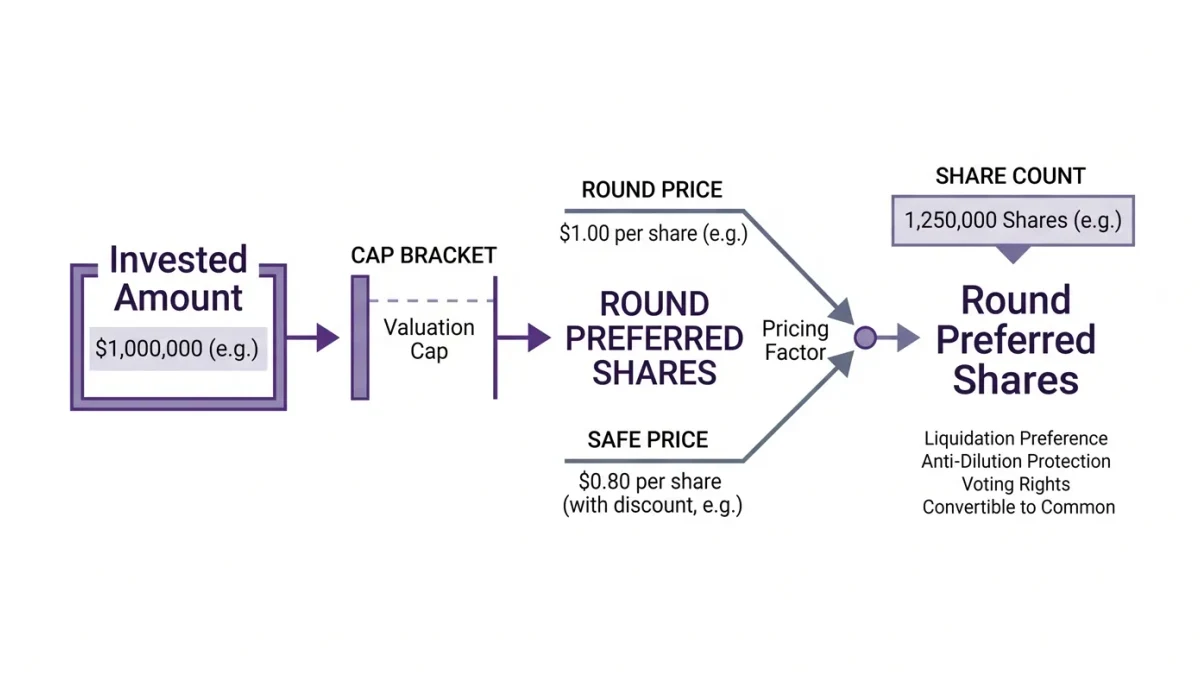
A SAFE — Simple Agreement for Future Equity, the instrument Y Combinator introduced in 2013 and open-sourced since — converts at the company's first priced financing, turning the invested amount into preferred shares at a price determined by the SAFE's valuation cap, its discount, or the round price itself, whichever gives the investor the most shares. Founders issue SAFEs because they close in days without interest, maturity, or negotiation over valuation; investors accept them because the cap bounds the price they will pay for a company that grows before its first priced round. Understanding the conversion arithmetic matters to both sides, because the equity cost of outstanding SAFEs is set at signing, not at conversion. This article walks the mechanics.
What Happens at the Priced Round?
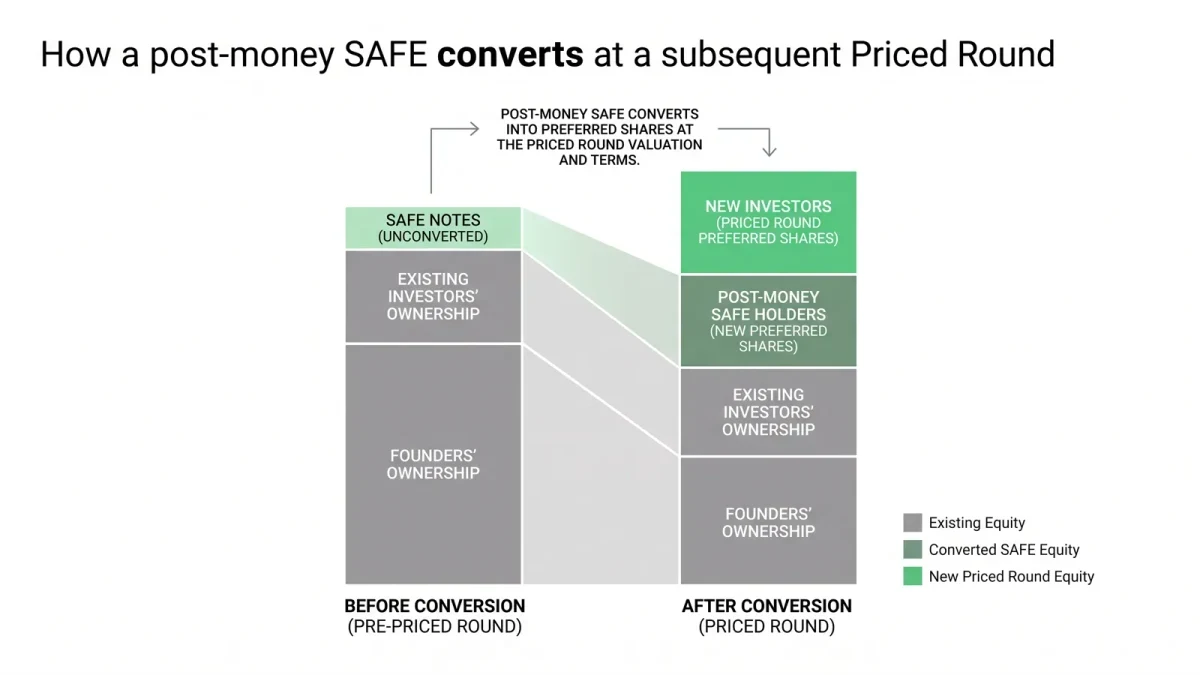
When the company sells preferred stock at a fixed price per share, each SAFE converts by buying that round's preferred stock — or an equivalent series — at the SAFE price instead of the round price. The SAFE price comes from two mechanisms, and the investor gets whichever is cheaper. Valuation cap: the SAFE price equals the cap divided by the company's pre-money fully-diluted capitalization, so a $5 million cap on a company raising at a $25 million pre-money lets the SAFE buy at one-fifth of the round price. Discount: with no cap or where the round prices below the cap, the SAFE buys at the round price minus a stated discount, commonly 10-20 percent. A $500,000 SAFE with a $5 million cap converting in a round priced at $25 million pre-money buys $2.5 million worth of round shares at the SAFE's $500,000 cost — a 5x paper multiple at signing, before any later outcomes.
What Do the Different Flavors Change?
SAFEs come in cap-only, discount-only, cap-and-discount (MFN between them), pre-money and post-money variants, and the post-money variant Y Combinator standardized in 2018 changes the founder math enough to matter. A post-money SAFE converts on the company's capitalization after the round is added but before the new money — meaning the SAFE percentage is fixed and knowable at signing, and successive SAFEs dilute only the founders, not each other. Pre-money SAFEs, the older form, share dilution among all SAFE holders and compute against the capitalization including converted SAFEs. Founders stacking multiple SAFEs should model both: the same headline cap produces different founder ownership depending on which flavor sits in the stack, and "post-money" is not a better default — it is a different one.
What About Pro-Rata Rights, Liquidity, and Failure?
Conversion brings details worth knowing. Most SAFEs carry pro-rata rights letting the investor participate in the converted round alongside new money, which preserves ownership through the dilution their own conversion causes. SAFEs have no maturity date and no interest — they sit indefinitely until a priced round, a sale, or a dissolution. In an acquisition, SAFEs typically convert to common or take their money back at a negotiated multiple, whichever the documents provide; in a dissolution, SAFEs stand behind almost everything — their payout is what remains after creditors and preferred preferences, usually nothing. MFN clauses let early SAFEs adopt better terms offered to later SAFE investors before the priced round, which is why SAFE stacks tend to converge on the best terms signed.
What Should Founders and Investors Model?
Founders should run the stack before any priced round: each SAFE's conversion shares, the dilution to existing holders, and the effective price the new investor's money pays after SAFE dilution — because sophisticated lead investors will do exactly that arithmetic and price it in. Investors should model ownership as of conversion, not as of signing, remembering that rounds and additional SAFEs signed later can shift pre-money flavor percentages. Both sides should treat the cap as the real negotiation: everything else in a SAFE is boilerplate, but the cap (and post- versus pre-money) is where the company is bought. The lesson: SAFEs defer the negotiation, not the economics — the price was set the day the cap was.