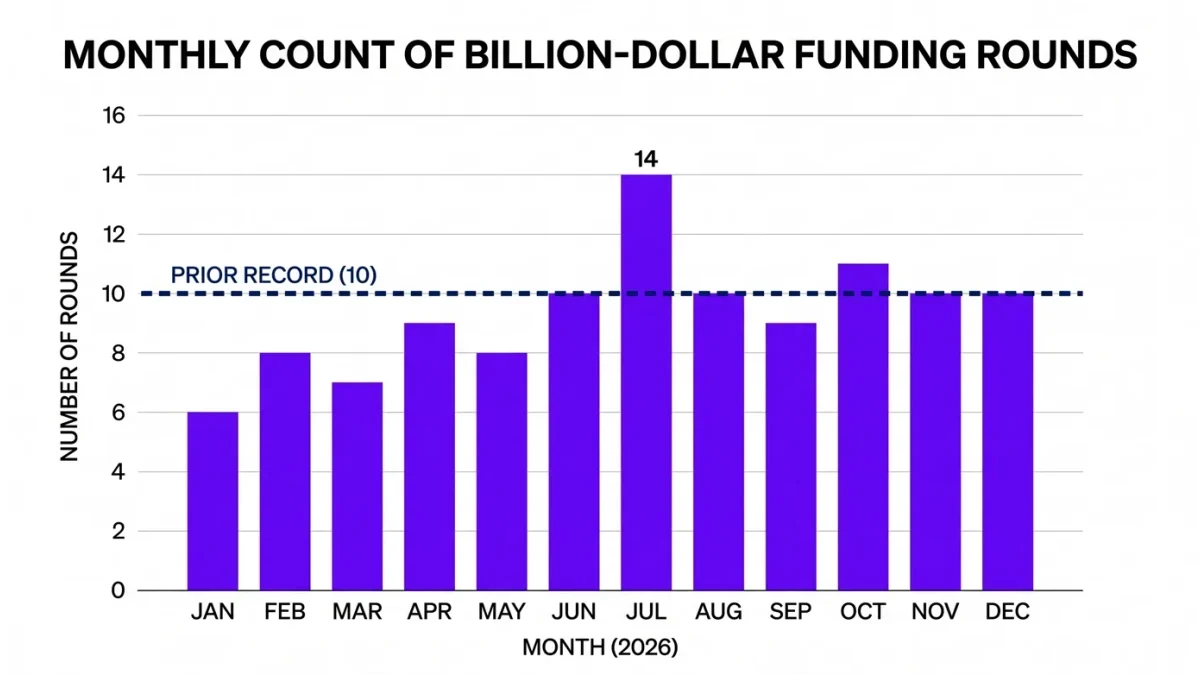
July 2026 produced 14 billion-dollar venture funding rounds — the highest count ever recorded in a single month, per Crunchbase data published August 4, 2026 — within a global total of $65 billion, up 100 percent year-over-year and 10 percent over June. The month followed a first half in which startups raised a record $515 billion, and it spread the record geographically: nine of the fourteen mega-rounds went to U.S. companies, two each to Germany and China, and one to Singapore.
What Were the Rounds?
Blue Origin's $10 billion raise — the space company's first external funding — topped the month, followed by Safe Superintelligence's reported $5 billion from Nvidia, Moonshot AI at $3.5 billion, and Kling AI at $2.8 billion. Germany contributed billion-dollar rounds for defense-tech company Helsing and drone-maker Quantum Systems. The month's total for mega-rounds set the count record but not the dollar record, and AI companies absorbed about $35 billion — roughly 53 percent of the month's funding, a lower share than Q1's 80 percent peak. U.S. startups took $39 billion, about 59 percent.
What Did Exits Look Like?
The exit side moved too: venture-backed M&A topped $9 billion in July with five exits above $1 billion, including Nscale's roughly $1.65 billion purchase of Anyscale and Cyera's $1 billion acquisition of Oasis Security. Twelve venture-backed IPOs debuted valued above $1 billion, led by ChangXin Memory Technologies at roughly an $85 billion debut — up 466 percent — and Bending Spoons at $18.5 billion. For founders, that combination — record mega-round counts plus an open acquisition and IPO window — is the strongest exit environment signal since 2021, with the caveat that both buyer types are concentrating on AI and adjacent infrastructure.
What Does It Change for Founders?
Two practical reads. The record round count with a falling AI share suggests capital is broadening within technology — defense, space, quantum, and memory hardware all posted billion-dollar months — which is encouragement for hard-tech and deep-tech founders whose theses sat outside last year's narrow AI window. And the healthy M&A and IPO activity changes negotiation posture: acquirers and public-market comparables are both active, so founders fielding offers in the second half can benchmark against real marks rather than theoretical ones. The standing caution from the Q1 data still applies: these records describe a market of mega-rounds most startups never touch, but the direction — more rounds, more acquirers, more listings — improves the climate at every stage beneath the headlines.
The takeaway for founders: July's fourteen billion-dollar rounds and $9 billion-plus of venture M&A mark the most open capital-and-exit environment of the cycle — hard-tech founders in particular are raising money in a market newly willing to price their work.