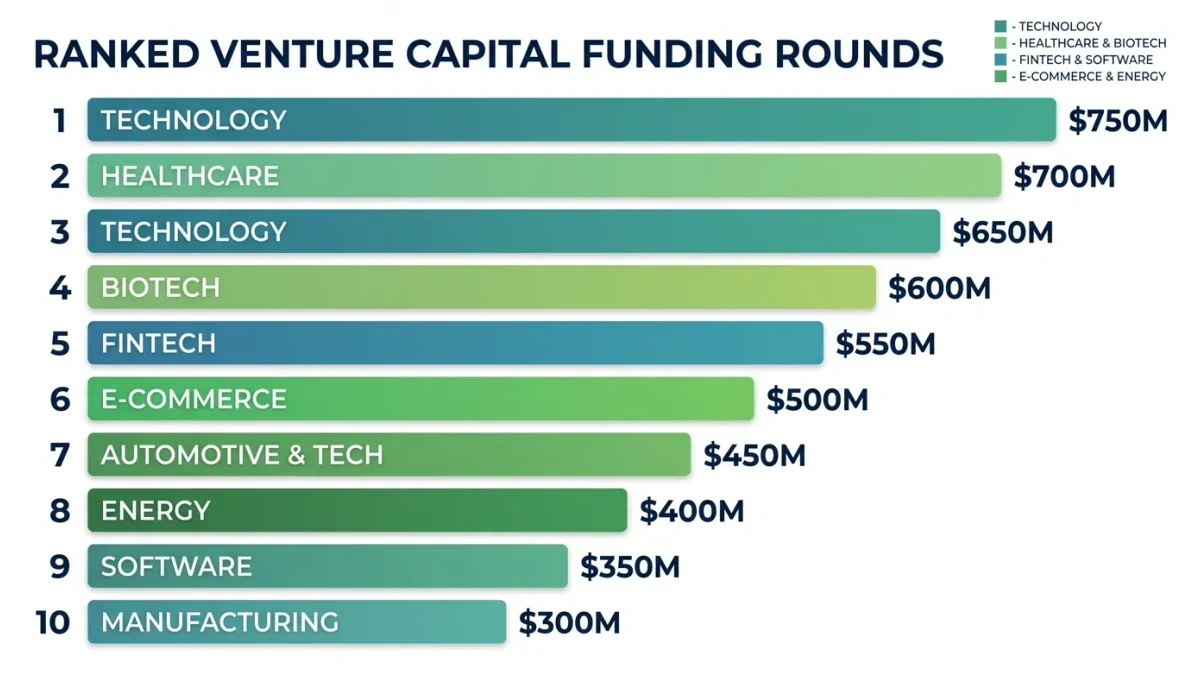
Spend-management software company Ramp raised $750 million at a $44 billion valuation — the largest of ten rounds of $300 million or more announced by U.S. startups in the week ending June 5, 2026, per Crunchbase News' weekly tracking — a week whose ten biggest deals together totaled roughly $4.6 billion and stretched from developer tools to fusion energy. The round, led by Iconiq, GIC, and the Ontario Teachers' Pension Plan, values a company selling corporate cards and finance automation at a level that would have been a late-stage public-company number not long ago.
What Else Was in the Week?
The $500 million tier crowded quickly. Impulse Space raised a $500 million Series D for spacecraft propulsion, passing $1 billion raised to date. Supabase, the open-source platform developers use to build AI applications, raised $500 million led by GIC at a $10.5 billion valuation — a signal of where AI-era infrastructure spending flows. Flourish, a foundational-AI startup modeling computation on the human brain, announced $500 million in initial funding from Jeff Bezos, Lux Capital, and Google Ventures. Below them: Helion's $465 million Series G for fusion energy at a $15.5 billion post-money valuation led by Thrive Capital, longevity-medicine company NewLimit's $435 million Series C led by Founders Fund and co-founded by Coinbase's Brian Armstrong, AI music company Suno at $400 million, robotics startup Generalist AI at $400 million, market-intelligence platform AlphaSense at $350 million, and defense-tech company Mach Industries' $300 million Series C at a $1.8 billion valuation.
What Does It Change for Founders?
The week continues Q1's pattern with a difference worth noting: the money is spreading beyond frontier-AI model companies into the picks and shovels around them. Supabase (developer infrastructure), Ramp (finance automation), AlphaSense (market intelligence), and Impulse Space (space hardware) are all picks-and-shovels businesses in their domains — the kind of company whose value rises with usage of a bigger technology rather than by winning the model race itself. For founders outside the mega-AI club, that is the encouraging read: investors are paying growth valuations for companies that make AI-era work cheaper or faster without training their own frontier models. The caution remains the same as the quarter's: these are nine-figure rounds at multi-billion valuations, a market most startups never touch — the lesson to borrow is directional, the prices are not.
The takeaway for founders building around AI: the week of June 5 shows where the growth capital sits — infrastructure, automation, and hardware at the edges of the AI stack — and a $500 million round for a developer platform is the clearest signal yet that the picks-and-shovels thesis is the one investors are funding hardest.