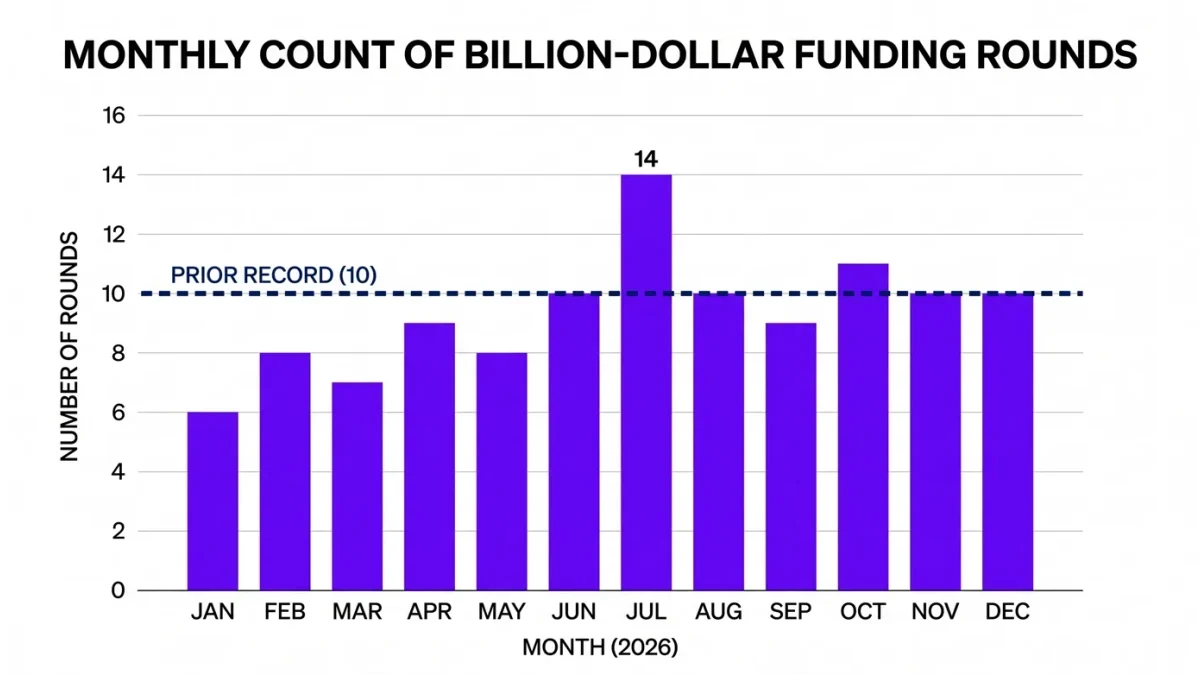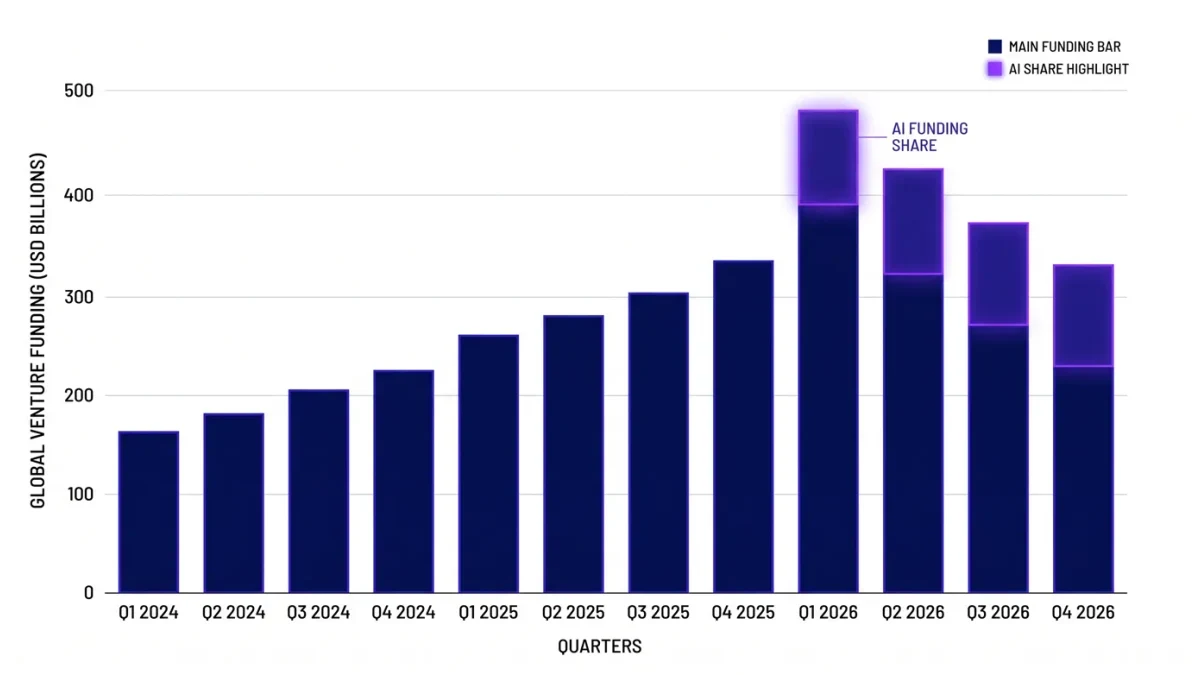
Global venture funding reached $300 billion across roughly 6,000 startups in the first quarter of 2026, an all-time quarterly record up more than 150 percent quarter-over-quarter and year-over-year, per Crunchbase data published April 1, 2026 — a single quarter that nearly matched 70 percent of all venture spending in 2025. The concentration is the story within the story: artificial intelligence companies absorbed $242 billion, 80 percent of global venture funding, versus a previous record share of 55 percent in early 2025.
What Drove the Record?
Scale, not breadth. Four of the five largest venture rounds ever closed in the quarter — OpenAI at $122 billion, Anthropic at $30 billion, xAI at $20 billion, and Waymo at $16 billion — together accounting for roughly $188 billion, about 65 percent of the quarter's total, with ten additional companies raising billion-dollar-plus rounds. U.S. companies captured $250 billion, 83 percent of the global figure; China followed at $16.1 billion and the U.K. at $7.4 billion. The stage breakdown shows where the money actually went: late-stage funding hit $246.6 billion, up 205 percent year-over-year, while early-stage reached $41.3 billion, up 41 percent, and seed $12 billion, up 31 percent — with seed deal count actually falling about 30 percent.
What Does It Change for Founders?
The environment is two markets at once. For founders of AI companies and late-stage businesses with proven traction, the market is the most liquid in venture history — record sums chasing a defined set of themes, with valuations to match. For everyone else, the record headline overstates the weather at the bottom of the market: seed dollars rose modestly while seed deal count fell by nearly a third, meaning fewer checks concentrated in fewer companies. Practical readouts follow from that split — seed founders should assume competition for dollars remains sharp despite the aggregate record; later-stage AI-adjacent companies should price ambition accordingly; and founders outside AI should not read the $300 billion as evidence their own raise has gotten easier. The consistent Crunchbase-series caution applies to all: mega-rounds dominate the totals, so headline figures describe a market most startups do not inhabit.
The takeaway for founders: the Q1 2026 record is real but narrow — 80 percent AI, two-thirds in four companies' rounds — so the practical question for any raise is which of the two markets the company is actually in.