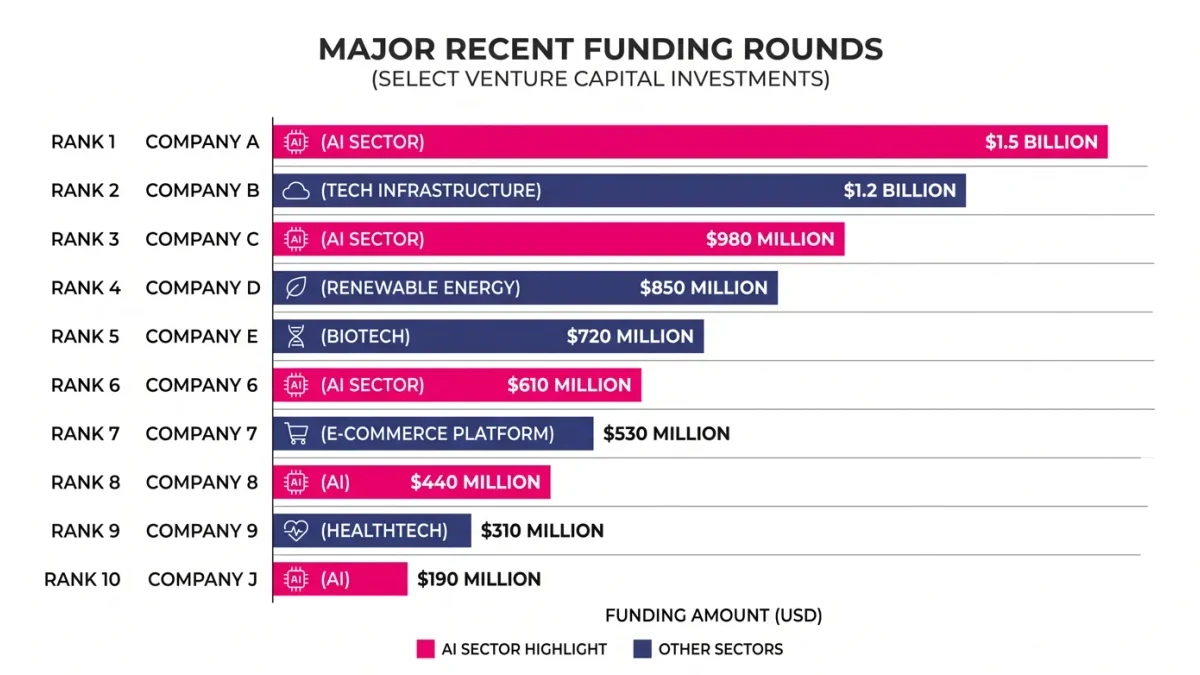
AI inference infrastructure company Baseten raised $1.5 billion in a Series F valuing it at $13 billion, the largest of the week's ten biggest U.S. startup rounds, with marketing analytics provider AppsFlyer raising a reported $1 billion at a $2.7 billion valuation close behind, per Crunchbase News' weekly roundup published June 26, 2026. The ten largest rounds together totaled roughly $4.5 billion, with AI companies taking five of the ten spots and biotech the second-largest theme.
What Was in the Week?
Beyond the two billion-dollar deals, Groq — the AI inference cloud provider — raised $650 million as it scales capacity, marking the week's clearest signal: two of the top three rounds went to companies whose product is running other companies' AI models. Ollin Biosciences raised $330 million for vision-disease therapies, and General Intuition — a foundational AI model trained through gameplay — raised a $320 million Series A at a $2.3 billion valuation. Peregrine Technologies took $250 million for its public-safety software platform at a $6.8 billion valuation, with Quantifind and the frontier lab Mirendil at $200 million each, and Upscale AI and Osanni Bio at $190 million apiece. European rounds added Berlin defense-tech company Stark at $569 million and Paris health insurer Alan's €480 million.
What Does It Change for Founders?
The week's composition confirms a trend visible since Q1: the inference layer — the infrastructure that runs AI models in production — has become venture capital's favored theme within the AI stack, distinct from the model developers themselves. Baseten and Groq selling compute and tooling to companies integrating AI mirrors what Supabase's raise signaled three weeks earlier: investors are funding the merchants of the gold rush at richer multiples than most miners. The second signal is valuation discipline by category: infrastructure rounds priced at $11-13 billion and platform rounds like Peregrine's at $6.8 billion, while a Series A with a credible AI thesis — General Intuition at $2.3 billion, Mirendil's $200 million seed — shows the very top of the early-stage market still commands 2021-era pricing. For founders raising below that tier, the lesson is positioning: the weeks keep proving that "we make AI work in production" out-raises "we are building AI" — a framing decision made in the pitch, not the technology.
The takeaway for founders: a $4.5 billion week with inference infrastructure on top repeats the year's clearest pattern — the money follows whoever makes AI cheaper and faster to run, and founders selling into that layer are pricing their rounds accordingly.