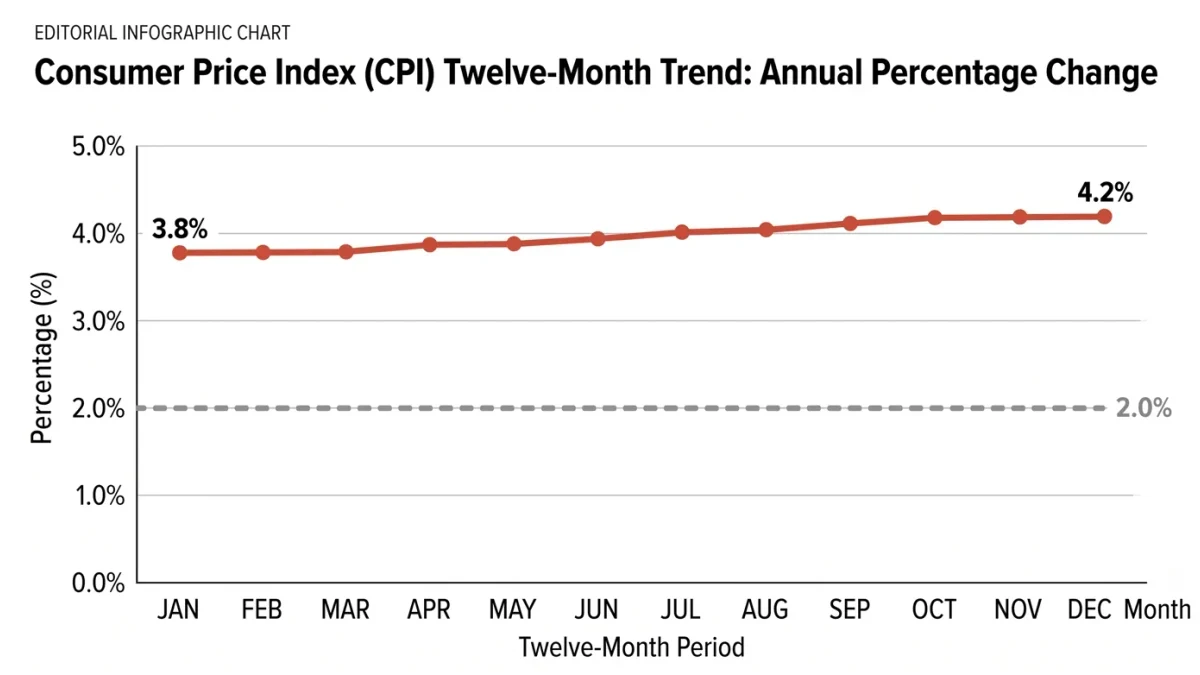
U.S. consumer price inflation accelerated to 4.2 percent year-over-year in May 2026 — the largest twelve-month increase in three years — with the CPI-U rising 0.5 percent on a seasonally adjusted monthly basis, per the Bureau of Labor Statistics' June 10, 2026 release as reported by CNBC and NBC News. The reading followed April's 3.8 percent and marked the second straight month of acceleration, confirming that the inflation buildup the Federal Reserve flagged in its March projections was still gaining rather than cresting.
Business News 7 publishes information, not economic or pricing advice.
What Did the Report Show?
The monthly pace of 0.5 percent annualizes well above anything near the Fed's 2 percent objective, and the 4.2 percent annual figure moved the economy from "elevated" back toward levels last seen in the early post-pandemic adjustment. Coming after April's 0.6 percent monthly jump, the report established a two-month pattern of broad, accelerating price pressure rather than a one-off spike — the sequence that historically transmits into wage bargaining, supplier contract renewals, and consumer expectations if it persists. For monetary policy, the reading landed on the hawkish side of the Fed's own raised forecast: the March Summary of Economic Projections had lifted core PCE to 2.7 percent for 2026 and cut the year's easing to roughly one move, and two CPI prints in a row above that trajectory left little room for even that single cut to arrive early.
What Does It Change for Small Businesses?
The businesses that priced for stickiness after April's report are now priced for acceleration, and those that did not have a quarter of catch-up. Three moves follow directly. Renew contracts with indexation: supplier agreements, service contracts, and lease escalations renewing this year should reference a published index or a stated adjustment mechanism, because two consecutive accelerating months make fixed-price multi-year commitments the party that loses. Re-run the price ladder: customer tolerance for annual increases is highest when inflation is headline news, and a business that has absorbed two months of cost acceleration without adjusting has lent its customers an interest-free subsidy. Fix financing now: the 4.2 percent print removes the case for waiting on rate relief — floating borrowers should convert or cap, and the cash side of the balance sheet should be swept into interest-bearing accounts where it is not already. The June data, due in the following month's release, will tell whether May was the peak; prudent planning treats it as the trend until a print says otherwise.
The takeaway for owners: May's 4.2 percent is the second act of the inflation story, not a rerun — index your contracts, adjust your prices, and fix your financing, because both the data and the Fed's posture now punish waiting.