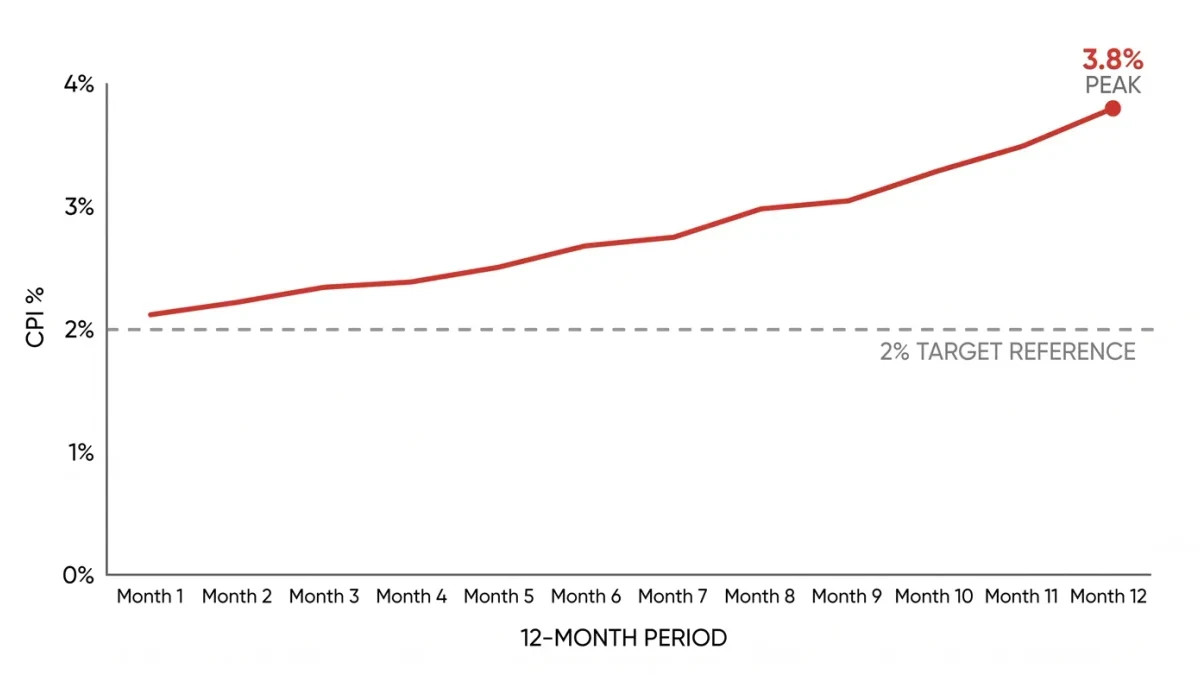
U.S. consumer prices rose 0.6 percent in April on a seasonally adjusted basis, pushing the twelve-month CPI-U increase to 3.8 percent — the highest annual inflation rate in about three years, per the Bureau of Labor Statistics' release of May 12, 2026. The acceleration marked the building of an inflation trend that had already led the Federal Reserve in March to raise its core PCE forecast to 2.7 percent and trim its 2026 cutting path to about one move, and the April number landed well above anything consistent with early relief.
Business News 7 publishes information, not economic or pricing advice.
What Did the Report Show?
The monthly increase of 0.6 percent annualizes to a pace far above the Fed's objective, and the 3.8 percent year-over-year figure put headline inflation nearly two percentage points above target. The report followed a period in which professional forecasters had expected 2026 to average nearer 2.6 percent — meaning the April data overshot the consensus frame rather than confirming it. For businesses, the composition matters as much as the level: a broad 0.6 percent monthly gain implies the pressure is economy-wide cost, not a single-category spike, which is the pattern that transmits into wages, supplier contracts, and consumer price expectations if it persists.
What Does It Change for Small Businesses?
Three practical consequences follow. Financing: the report hardens the case that the Fed's one-cut outlook was optimistic on the cautious side — businesses should finalize fixed-rate borrowing decisions now rather than waiting for relief that the inflation path does not support. Pricing: a three-year high in consumer inflation changes customer psychology in the buyer's favor for increases — buyers are themselves seeing rising prices everywhere, which historically makes well-communicated, moderate annual increases easier to sustain; owners who have deferred increases since 2024 should run that review against current input costs immediately. Costs: contracts renewing this year — supplier agreements, leases with escalations, labor — should be modeled at the April trend rather than the forecasters' gentler path, and cost-indexation clauses are worth negotiating in wherever counterparties will accept them. The inflation that the March projections flagged has now arrived in the consumer data, and the businesses that adjust contracts and prices in the same quarter will keep margin that the unprepared will absorb.
The takeaway for owners: April's 3.8 percent confirms sticky, broadening inflation — fix your financing, re-price with discipline, and index your renewals, because waiting for relief is now a strategy the data does not support.