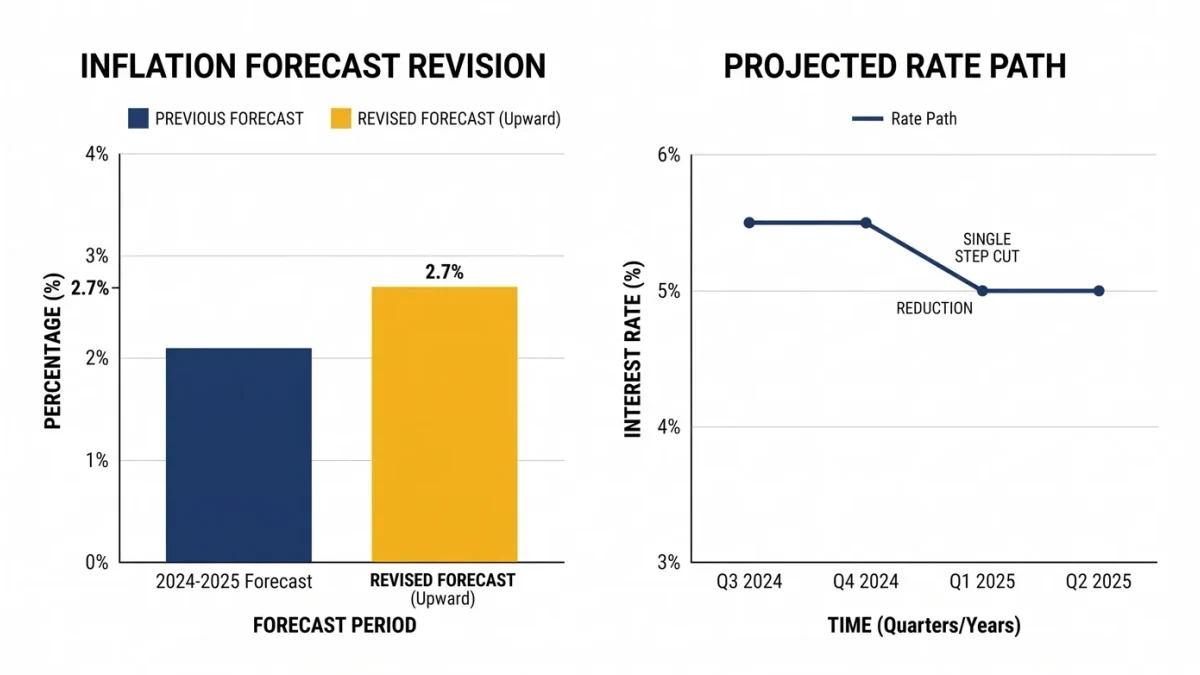
The Federal Reserve held the federal funds rate steady at 3.50-3.75 percent on March 18, 2026, a widely expected decision whose real content sat in the accompanying Summary of Economic Projections: officials raised their core PCE inflation forecast to 2.7 percent for 2026 — 2.2 percent for 2027 — and the dot plot signaled roughly one rate cut for the remainder of the year, per the committee's statement and J.P. Morgan Asset Management's analysis. The combination of a higher inflation path and a thinner cutting path told markets that the easing cycle's easy part was behind them.
What Did the March Package Say?
Three elements moved together. The rate decision extended the pause begun in January — a stance the committee would subsequently maintain through multiple meetings, with July's decision marking a fifth consecutive hold. The inflation forecast moved up, which is the projection doing the explaining: a 2.7 percent core PCE expectation sits further from the Fed's 2 percent objective and justifies patience. And the median dot implied about one cut in 2026, down from what markets had priced entering the year. For business readers, the translation is simple — the cost of money this year is now credibly 3.5 to 3.75 percent at the short end, with one possible reward cut, and financing plans should assume exactly that.
What Does It Change for Small Businesses?
The one-cut outlook collapses the refinancing case for waiting. Owners who deferred converting floating lines to fixed, hoping 2026 would deliver a series of cuts, now hold positions the Fed itself does not expect to pay off — the disciplined move is locking fixed terms on any debt with a horizon past year-end and letting floating exposure ride only where balances are small. The raised inflation forecast has a second-order effect worth more attention than the rate path: it signals the Fed expects sticky input costs, which strengthens the case for the annual price-review discipline — contracts with cost-adjustment clauses, supplier terms revisited, inventory bought forward where storage allows — that protects margin in a persistently above-target world. And the single projected cut, if it arrives, is likely to land late in the year; a seasonal business financing a fourth-quarter build should plan its credit needs against today's rates, not December's hoped-for ones.
The takeaway for owners: March's projections took the discount out of the market's rate story — one cut, later, maybe — so the businesses that win 2026 on financing are the ones that fixed their terms in the first half and priced their inputs for stickiness rather than relief.