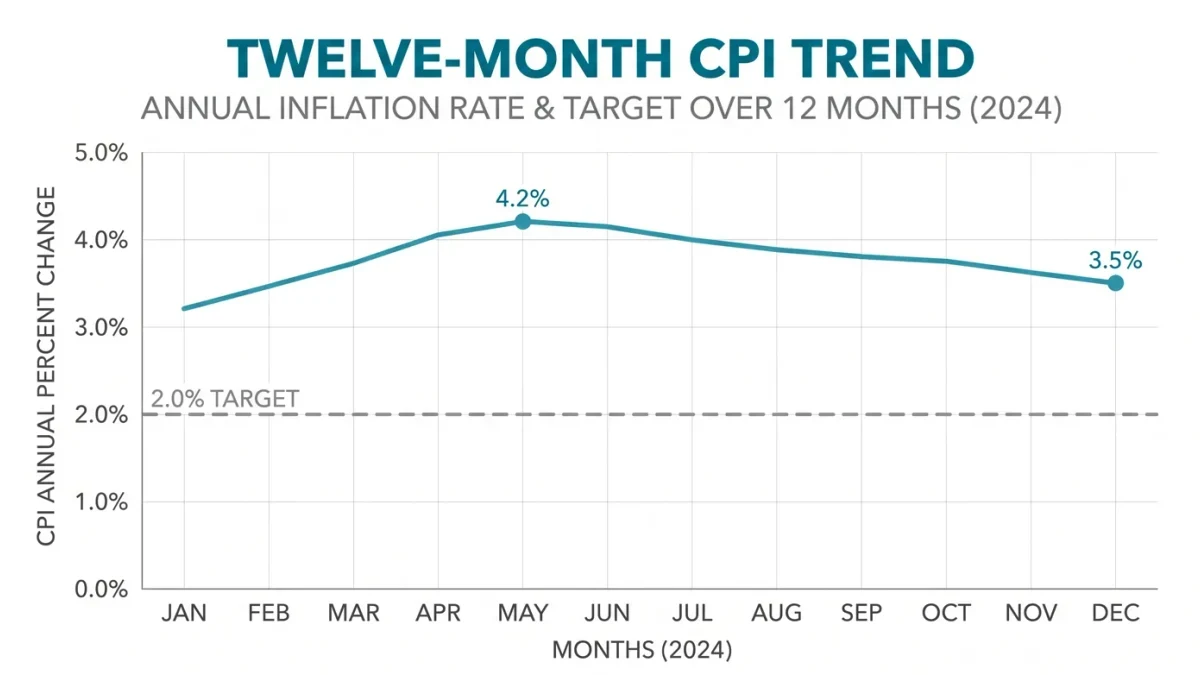
U.S. consumer price inflation slowed to 3.5 percent year-over-year in June 2026, down from May's 4.2 percent, per the Bureau of Labor Statistics' release of July 14, 2026 — the first retreat after three consecutive months of acceleration, landing roughly in line with expectations and easing, without ending, the year's inflation problem. The print followed the pattern financial trackers noted into the summer: a cooling trend from the spring peak that still left the annual rate well above the Federal Reserve's 2 percent objective.
Business News 7 publishes information, not economic or pricing advice.
What Did the Report Show?
The 0.7-percentage-point drop in the annual rate was one of the larger one-month improvements of the cycle, aided by the base effect — June 2026's index measured against stronger year-ago prices — as well as genuine cooling in components that had driven the spring spike. The level, however, remained restrictive territory: 3.5 percent annual inflation with a Fed that has held its policy rate at 3.50-3.75 percent all year is not an environment of relief, merely one of less deterioration. For the Federal Reserve, the report keeps the single 2026 cut its March projections signaled alive but does not argue for it urgently — the committee's July meeting, held two weeks after this release, kept rates unchanged as expected in a continued split vote.
What Does It Change for Small Businesses?
A cooling print after two accelerating ones is a scheduling signal, not an all-clear. The planning moves it adjusts: pricing — businesses that pushed through increases in the spring now face customers reading "inflation cooling" headlines, so the discipline shifts to holding the increases already taken rather than stacking new ones; the mistake to avoid is a rollback, which converts a margin repair into a permanent concession. Contracts — the indexing clauses negotiated during the spike remain the right structure, but expectations for adjustment frequency can moderate; annual indexing with a 3-to-4 percent assumption is more realistic than the spring's monthly repricing. Financing — one improving print does not change the rate path; the Fed held in July and the single projected cut, if it comes, arrives late — so the fixed-versus-floating audit from the spring still stands. The core read for owners: the direction has turned, the level has not, and the businesses that keep their spring adjustments in place while their competitors unwind them will carry the margin difference into 2027.
The takeaway for owners: June's 3.5 percent is the first genuinely good inflation news of the year — treat it as permission to stop tightening, not to start unwinding, because the level still prices your costs and your credit well above the old normal.