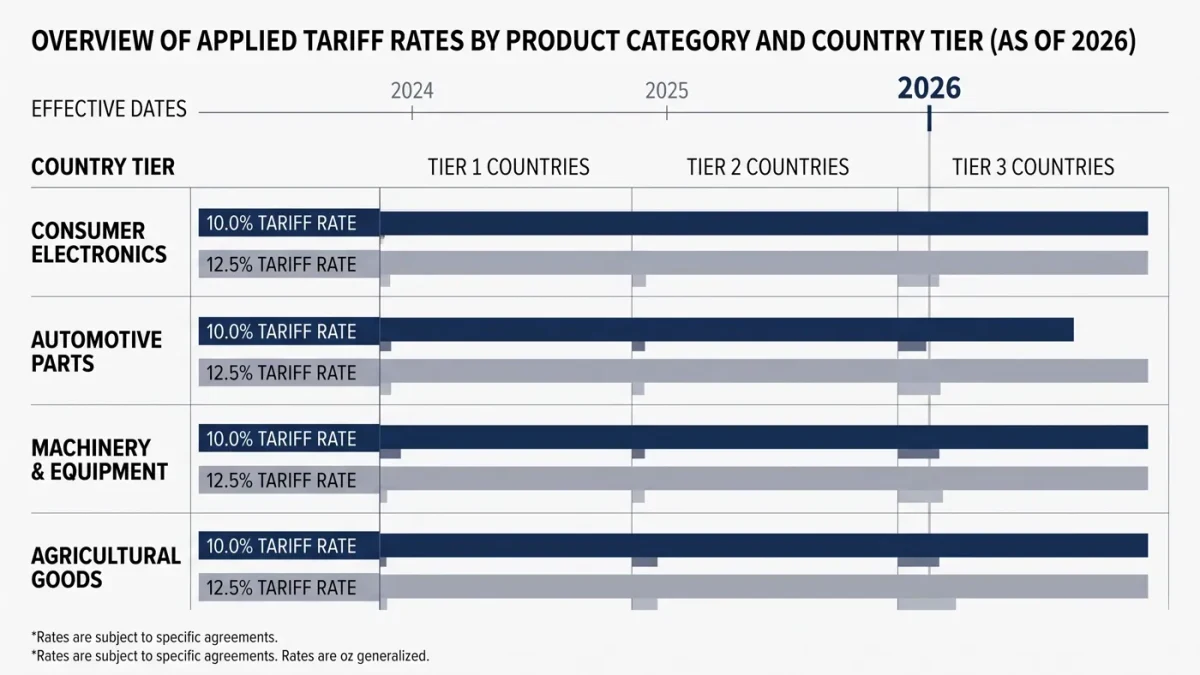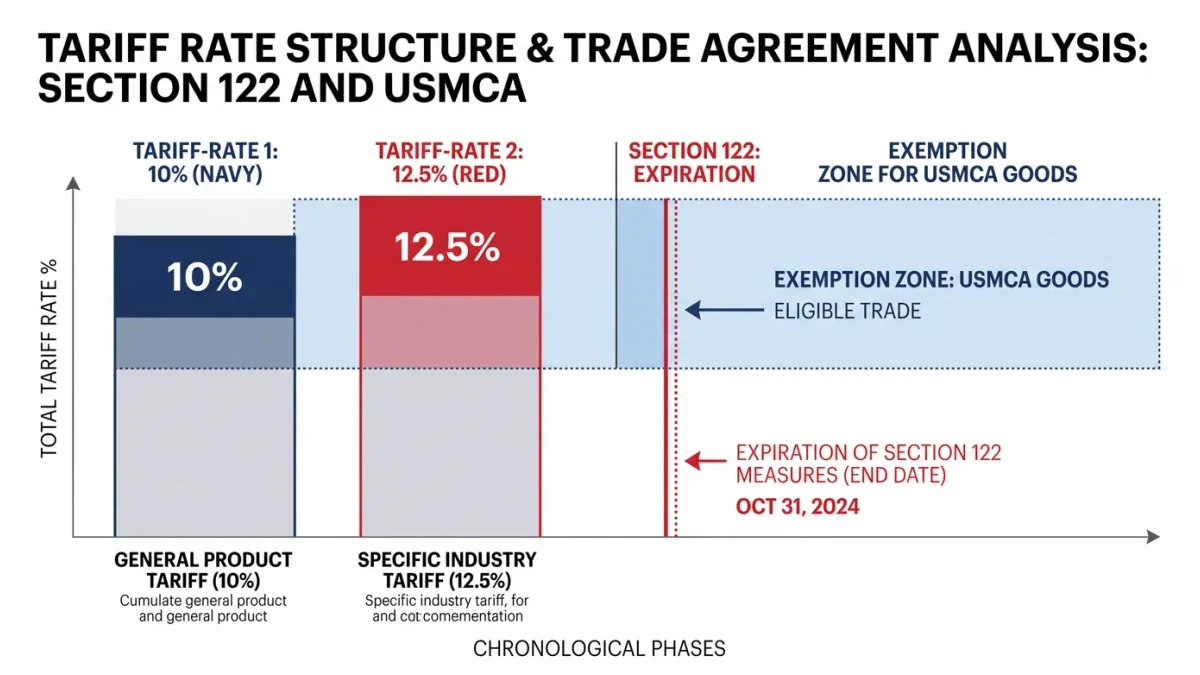
U.S. trade treatment shifted to a new legal footing on July 24, 2026, when Section 301 tariffs took effect covering the top 60 U.S. trading partners — 99.4 percent of U.S. imports — under a final action the Office of the U.S. Trade Representative announced July 23, 2026, replacing Section 122 balance-of-payments tariffs that hit their 150-day statutory sunset the same day. The new structure charges 10 percent on 17 economies with forced-labor import prohibitations or reciprocal-trade commitments, and 12.5 percent on the other investigated economies, for goods entered for consumption on or after 12:01 a.m. ET, July 24, per USTR's action and CBP implementation guidance.
What Changed and Why?
The tariffs arise from Section 301 investigations into whether the 60 trading partners impose and effectively enforce prohibitions on goods produced with forced labor. USTR proposed the action June 2, 2026, took over 1,600 written comments and held public hearings July 7–9 before finalizing. The two-tier outcome moved Honduras, India, Jordan, Sri Lanka, and Trinidad and Tobago down from the proposed 12.5 percent to 10 percent, joining Argentina, Bangladesh, Cambodia, Canada, Ecuador, El Salvador, Guatemala, Indonesia, Malaysia, Mexico, Pakistan, and the United Kingdom at the lower tier. For certain products from the EU, Taiwan, Japan, Korea, and Switzerland, rates are calculated considering the normal MFN tariff rather than stacked flat, and tariff-rate quotas apply to textiles from Bangladesh, Cambodia, Indonesia, and Malaysia tied to imports of U.S. cotton and textile inputs.
What Should Importers Check First?
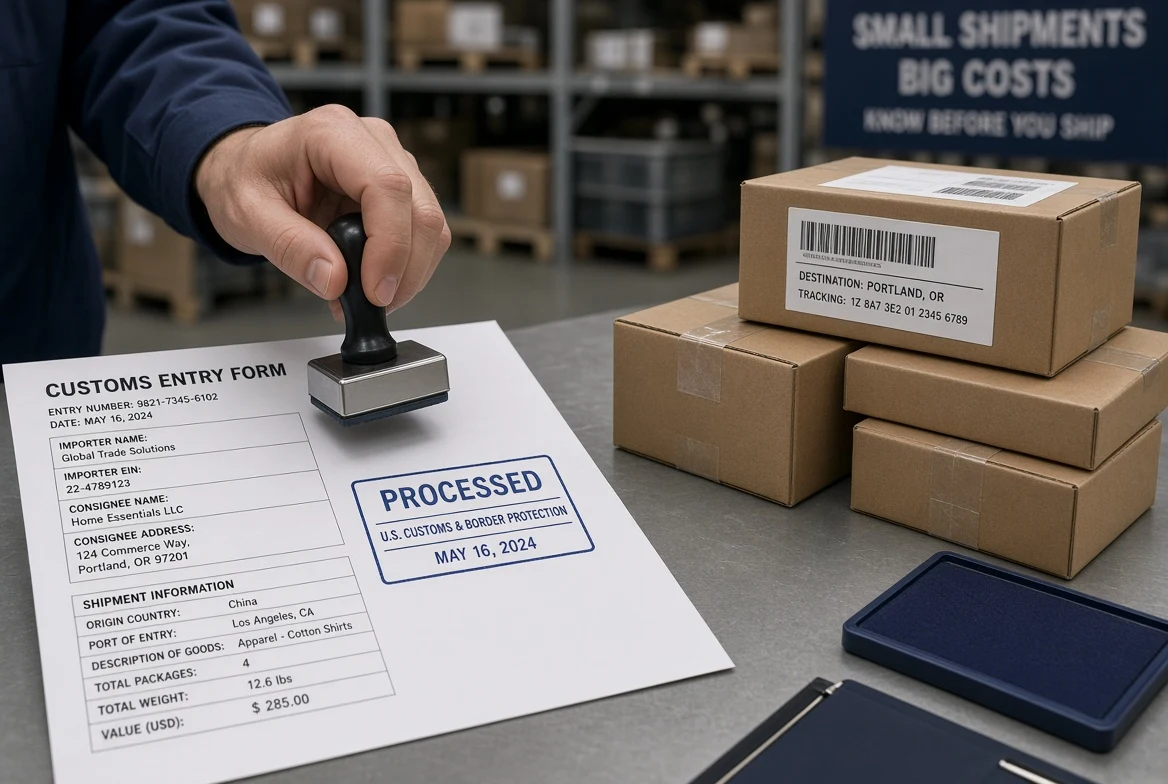
The exemptions decide real exposure. Annexes to the action carve out Section 232-covered articles, certain raw materials and shortage-risk goods, products not producible in sufficient U.S. quantities, informational materials and donations — and, critically for North American supply chains, goods qualifying under USMCA and CAFTA-DR duty-free textiles and apparel. That means importers who maintain current USMCA certifications on Mexican and Canadian goods largely avoid the new tariff, which raises the commercial value of rules-of-origin paperwork substantially. CBP's CSMS #69326983 sets out the new Chapter 99 headings, foreign-trade-zone treatment, and the stacking sequence for entry summaries — the operative instructions for brokers. A limited in-transit exception applies to goods already underway at the effective time.
What Does It Change for Small Businesses?
For small importers, three practical moves follow. Re-run landed-cost models with the correct tier for each origin country — the difference between 10 and 12.5 percent is a margin question on any price-sensitive line. Verify USMCA qualification on North American goods, because an unqualified Canadian or Mexican shipment now pays what a certified one does not. And watch classification: the exemptions for raw materials and non-producible products mean HTS-level analysis, not country-level assumption, decides what actually pays. Businesses that survived the de minimis suspension this June already know the drill; this is another re-pricing of the same supply chains.
The takeaway for owners: the tariff floor covering 99.4 percent of imports is now statutory rather than emergency-temporary — the planning assumption for the next several quarters is that these rates persist, and the exemptions, not the headlines, are where the money is.