The qualified business income (QBI) deduction allows eligible owners of pass-through businesses — sole proprietorships, partnerships, S corporations, and most LLCs — to deduct up to 20 percent of their qualified business income on their individual returns, within taxable income limits set annually by the IRS. For a profitable small business below the income thresholds, the deduction is effectively a rate cut on business profit, computed on the owner's Form 1040 rather than the business return. This article explains how the deduction works, where it phases out, and what owners should check — while noting that the provision's scheduled post-2025 treatment was the subject of extended legislative debate, so owners should confirm current-law status with their tax preparer each year.
What Counts as Qualified Business Income?
QBI is the net amount of qualified items of income, gain, deduction, and loss from a qualified trade or business — broadly, the ordinary profit of the business as it flows to the owner's return. Excluded from QBI are wages paid to the owner as an employee of an S corporation, guaranteed payments to partners for services, capital gains and losses, interest income unrelated to the business, and certain dividends. The deduction also cannot exceed 20 percent of the owner's taxable income minus net capital gain, an overall ceiling that binds when investment income dominates. Owners of multiple businesses compute QBI per business and aggregate, with losses carried forward reducing future QBI.
Where Do the Thresholds and Limits Bite?
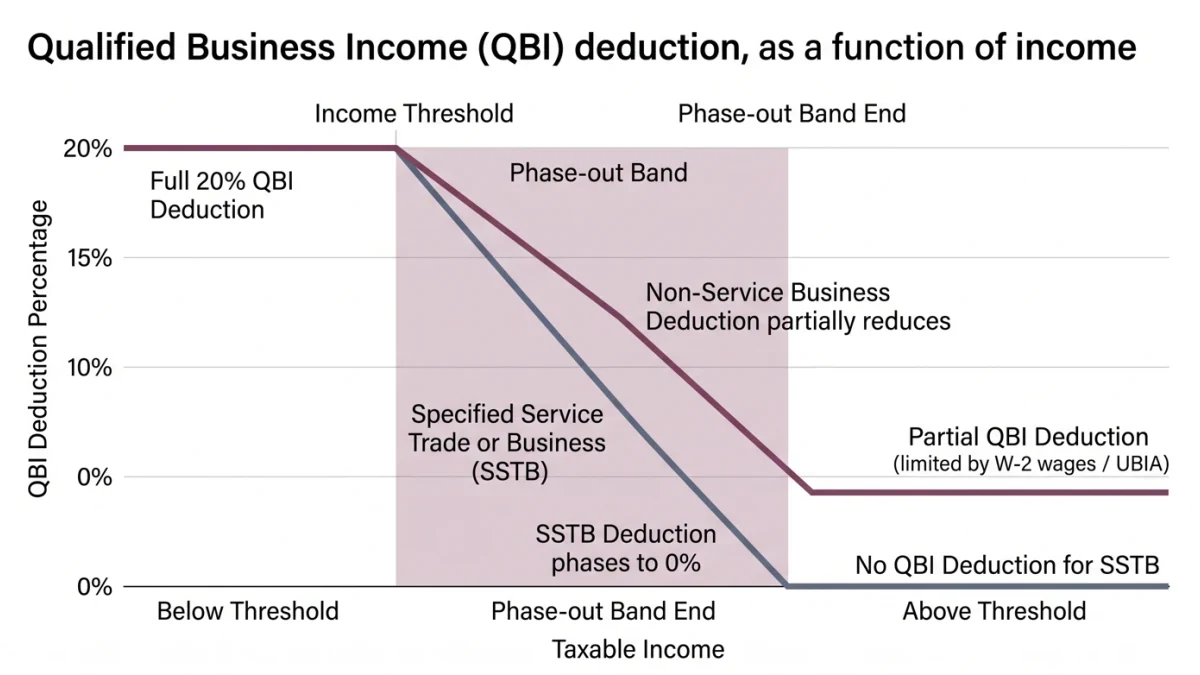
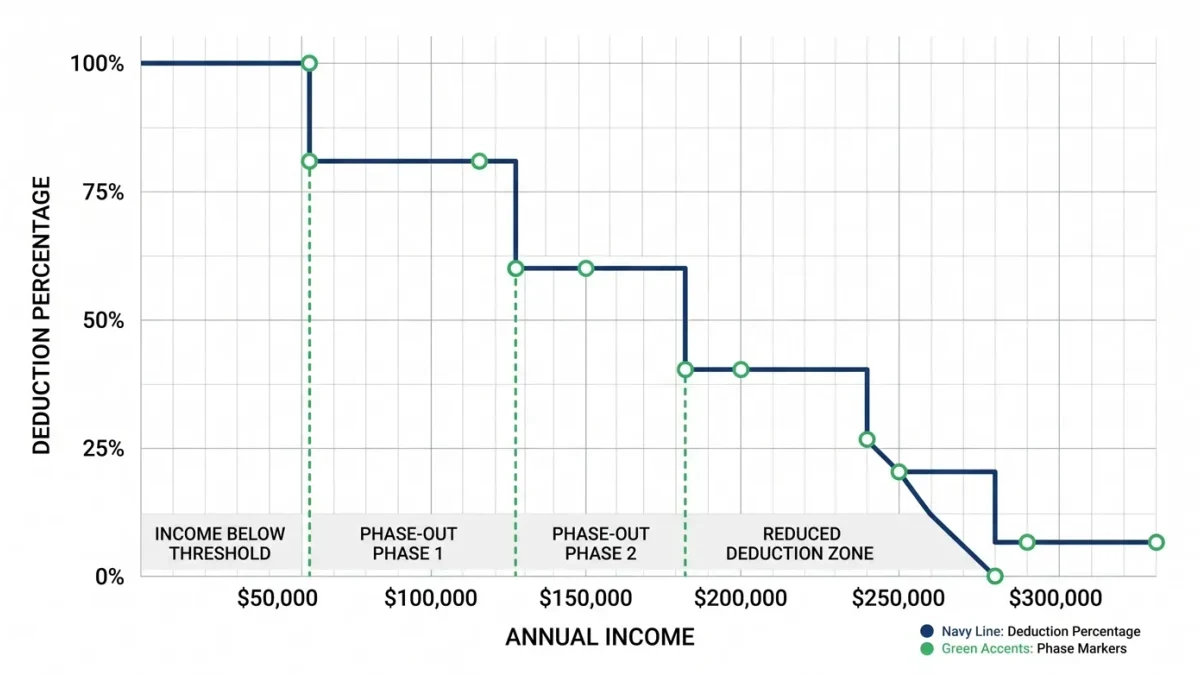
Two regimes divide taxpayers, indexed annually. Below the threshold — in recent years roughly $191,950 single and $383,900 married filing jointly — virtually all qualified business income qualifies for the flat up-to-20-percent deduction regardless of business type. Above it, two restrictions phase in over roughly the next $50,000/$100,000 of income. The first applies to specified service trades or businesses (SSTBs): fields like consulting, law, medicine, financial services, and athletics, where the business's principal asset is the skill or reputation of its owners — above the phase-out range, SSTB income loses the deduction entirely. The second, the W-2 wage and UBIA limitation, caps the deduction at the greater of 50 percent of W-2 wages the business pays or 25 percent of wages plus 2.5 percent of the unadjusted basis of qualified property — which penalizes capital-intensive but low-payroll businesses above the thresholds.
What Planning Levers Do Owners Actually Use?
Three levers recur in practice. Entity choice: because S corporation wages are excluded from QBI but also count toward the W-2 wage limitation, owners above thresholds sometimes adjust the salary-distribution split — a computation with competing payroll-tax effects that belongs entirely with a tax professional. SSTB timing: owners near the phase-out range may manage taxable income — retirement contributions, equipment timing — to stay below it in a given year. And grouping elections let owners treat multiple activities as one business for the wage test, which can matter when one entity carries payroll and another carries profit. None of these are exotic; all of them are year-end decisions that vanish after December 31, which is why QBIT planning belongs in the autumn tax conversation rather than the spring one.
What Should an Owner Verify This Year?
Three questions for the preparer: is the business an SSTB, and where does household taxable income sit relative to the current-year thresholds; does the business pass the W-2 wage test if income is above the line; and is the deduction being computed on the correct base — profit allocated to the owner, not revenue, and net of retirement contributions and self-employment nuances. The deduction is claimed on the individual return, so pass-through owners see it only if someone computes it. The lesson: QBI is a substantial standing benefit for eligible owners — and an unclaimed deduction for those whose returns were prepared without checking.