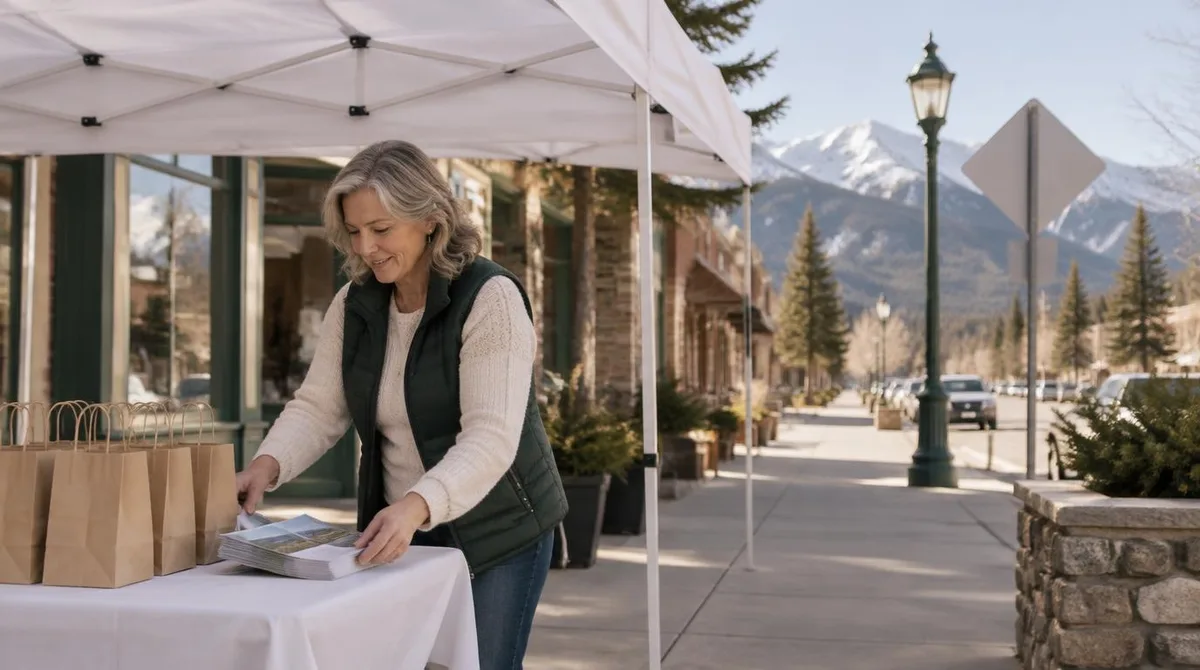
Woodland Park treats Small Business Saturday as more than a date on the calendar. On Saturday, Nov. 28, the city's Main Street volunteers will set up a tent outside Zebz Outfooter and hand out bags of goodies from 10 a.m. to noon, along with water and maps of business locations downtown and elsewhere. Stores around town will run coupons and deals, all aimed at one thing: getting people to shop local.
The event is small in scale, but the thinking behind it is worth unpacking. Small Business Saturday works because it converts community goodwill into a measurable behavior — a purchase — at a moment when holiday spending decisions are being made. And in a place like Teller County, the argument for redirecting that spending is unusually concrete. This connects to our earlier piece, Why Small Business Investment Decides Whether a Downtown Thrives. This connects to our earlier piece, Why Small Business Investment Decides Whether a Downtown Thrives.
The details come from reporting in the Pikes Peak Courier. According to the Courier's coverage, Main Street's bags include fliers from multiple businesses with information about what is going on in the community, plus treats and specials. "Main Street wants to focus on small business," Anita Riggle, the city's economic development and budget analyst, told the paper.
Why a giveaway tent is smarter marketing than it looks
A bag of treats and a map sounds modest. Look closer and it is a distribution channel. The fliers inside the bags are supplied by the businesses themselves, which means the city is aggregating local marketing into a single free touchpoint that reaches shoppers at the exact moment they are deciding where to spend. A solo retailer could not buy that placement.
This is the quiet work Main Street organizations do: they solve a coordination problem. Individual shops each have a small voice; a coordinated day with a physical anchor point gives all of them a larger one. Riggle's framing — that the focus is small business itself, not any single store — is the tell. The tent is infrastructure, not promotion.
What the numbers behind the push actually say
The chamber's case for shopping small rests on figures worth reading carefully. According to Debbie Miller, president of the Greater Woodland Park Chamber of Commerce, writing in the Courier, American Express reports that consumers have spent an estimated $241 billion at small businesses on Small Business Saturday since the holiday began in 2010. In its 2025 survey, 95% of small business owners said community support is what keeps them thriving.
The most locally specific number is the one that matters most here. Miller cites a Capital One 2025 study showing that $68 of every $100 spent in Teller County stays in Teller. That is the multiplier argument in one figure: money spent locally circulates through wages, supplier purchases and rent before it leaves. As Miller puts it, a purchase rarely ends at the register — it helps a business pay employees, buy goods and services, and keep its doors open for the next customer.
Two cautions apply. The $241 billion is an estimate from American Express, which reports the holiday began in 2010, so it is a self-interested party's own tally. And the $68 figure describes Teller County specifically; it cannot be transplanted to other markets. But as a local argument, it does the job. It tells a shopper that the same $100 does more work in the community when spent at the coffee shop than at a national chain.
The broader lesson for owners anywhere
Woodland Park's approach is a template any small business community can study. It has three parts: a shared date that concentrates demand, a physical gathering point that creates an event out of shopping, and a data-backed narrative — the local multiplier — that gives shoppers a reason beyond convenience. None of it requires a large budget. As Miller notes, shopping small does not require one: stop in for coffee, buy a gift, book a service or tell a friend about a business you appreciate.
For individual owners, the takeaway is about participation rather than scale. A flier in the bag, a coupon on the day, a staffed door — these are low-cost ways to be present when community attention peaks. The chamber's own invitation is to begin holiday shopping locally, visiting a business you already love and discovering one that is new to you.
Owners thinking about the wider commercial mechanics of visibility can read more about how local SEO works for a small business, because the online version of the Main Street map is where most shoppers now start. And the argument for keeping local spending local is developed further in why small business investment decides whether a downtown thrives.
What happens after Nov. 28
The honest reading is that one Saturday cannot carry a local economy. Miller herself frames it that way: Small Business Saturday is one day, but the choices made that day help shape the local economy all year. The event's real function is to start habits — a new customer, a first visit, a word-of-mouth recommendation — that outlast the tent on the sidewalk.
For the businesses in those bags of goodies, that is the measurable outcome to watch: not the day's receipts, but whether the map in a shopper's hand turns into a return trip in February. The evidence here supports the intent, not yet the result. That is the part worth checking next year.