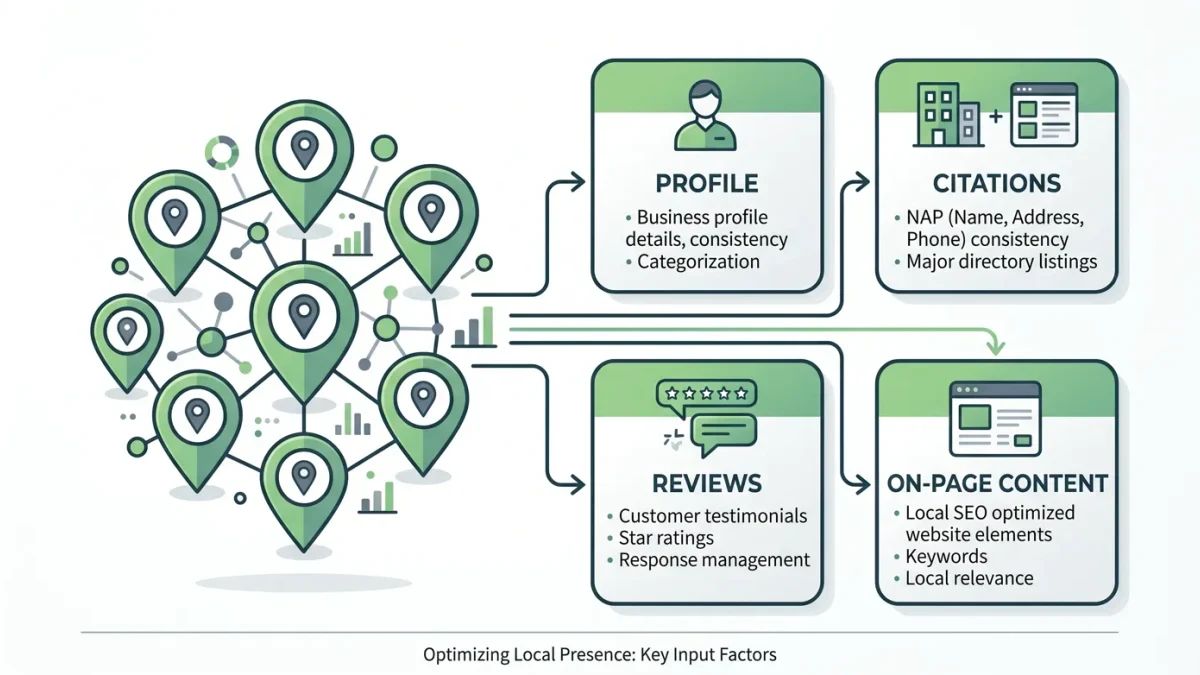
Local SEO — appearing in map results and "near me" searches — is driven by four factors a small business controls directly: a fully completed Google Business Profile, identical business name, address, and phone data across the web, a steady stream of customer reviews, and website pages that clearly state services and service areas. Google's own guidance to businesses says relevance, distance, and prominence decide local ranking, and most ranking problems trace to those inputs being incomplete rather than to any technical deficiency. For businesses whose customers arrive by search — trades, clinics, restaurants, local services — the work is among the highest-return marketing available, because it competes on effort rather than budget. This article covers the mechanics.
Business News 7 publishes information, not marketing advice; results vary by market and competition.
Why Is the Google Business Profile the Center of Gravity?
The Business Profile is the object Google ranks in Maps and the local pack — the map-and-three-listings block at the top of many local searches. Completeness is the baseline: every category, service, hour, and photo field filled, with services listed individually because each one widens the set of queries the profile can match. Posts, questions answered, and regular photo additions signal an active business. The profile also hosts the two things customers interact with most — reviews and booking or calling buttons — so its practical role is conversion as much as ranking: searchers act from the profile without ever reaching the website.
What Are Citations and Why Do They Still Matter?
Citations are mentions of the business's name, address, and phone on other sites — directories, industry listings, chamber pages, social profiles. Their value is consistency: when the same data appears everywhere, search engines trust the entity; when listings disagree, trust and ranking suffer. The workflow is unglamorous: claim and correct the major data aggregators and top directories, ensure the website displays the information identically including on every page footer, and add industry-specific listings where they exist. Citation work is mostly a one-time cleanup with periodic checks, not an ongoing purchase — businesses paying monthly for citation services should verify what is actually being maintained.
How Do Reviews Move Rankings and Revenue?
Reviews are the local factor that compounds: quantity, recency, and the owner's response rate all feed prominence, and the profile's star average shapes click and call behavior before ranking matters at all. The operational pattern that works is systematic asking — a review link sent after completed work, a tablet at the counter, a QR code on the receipt — because volume comes from process, not from hoping. Responses matter as much: replying professionally to every review, including negative ones, both signals engagement and gives prospective customers the impression of a business that shows up. Google prohibits incentivizing or gating reviews — filtering requests only to happy customers violates its policies — so the compliant method is asking everyone and making service worth reviewing.
What Does the Website Itself Need?
A handful of on-page basics carry most local weight. A page per service, each naming the service and the locations served in plain language, matched to the profile's service list. Location in the page titles and headers where honest. Fast mobile loading, since most local searches occur on phones and Google indexes mobile-first. Embedded structured data marking the business as a local entity helps search engines parse the facts. And consistent photos matching the profile. Businesses in multiple towns scale this with a page per town pairing real local relevance — projects, addresses served, staff — rather than copy-paste text with the town name swapped, which Google's spam policies specifically target.
The lesson: local SEO is an operations discipline wearing a marketing hat — complete data, earned reviews, and clearly labeled pages, maintained the way a clean storefront is maintained, and rewarded the same way.