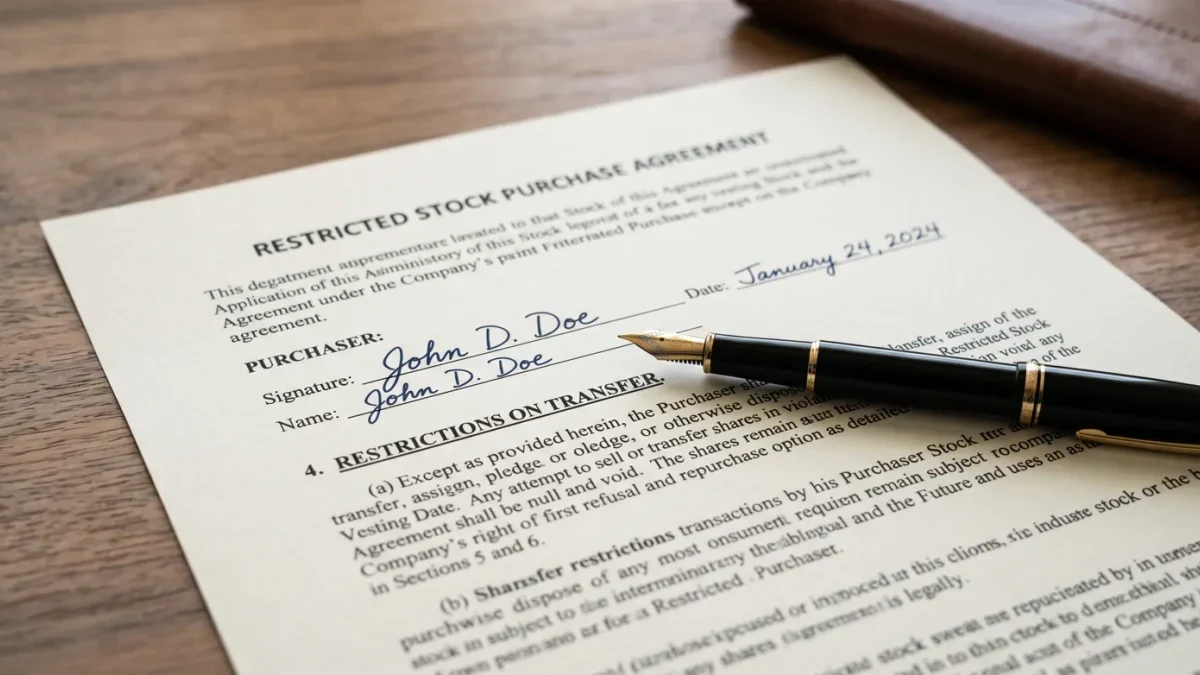
A founder vesting schedule is the agreement under which each founder earns their equity over time, typically four years with a one-year cliff, and its purpose is not distrust — it is damage control when a co-founder leaves early. Venture investors treat unvested arrangements as standard diligence items: a cap table where a departed founder keeps a large stake permanently is one of the most common reasons an investor passes. The mechanics are simple, and the cost of ignoring them is severe, so this article explains what vesting does, clause by clause.
How Does Four Years With a One-Year Cliff Work?
Under the standard schedule, a founder holds shares subject to a repurchase right: if they leave before the first anniversary — the cliff — the company can buy back all of their unvested shares, usually at the original nominal price. On the cliff date, 25 percent of the total vests at once; the remainder vests monthly over the following three years. A founder departing at month 14 therefore keeps roughly two years' worth of nothing — 25 percent plus two months — while a founder departing at month 40 keeps about 70 percent. The schedule converts time served into equity retained, automatically, without negotiation at the worst possible moment.
What Happens Without Vesting When a Co-Founder Leaves?
The failure mode is arithmetic. Two founders split 50/50 with no vesting; eight months in, one leaves for a job in another city. That person still owns half the company forever. The remaining founder now cannot issue meaningful equity to a replacement, investors see half the cap table owned by someone contributing nothing, and every future round inherits the defect. Documented investor guidance and standard venture practice treat this as close to unfixable later — the departed founder must voluntarily give back equity, which rarely happens. Vesting prevents the situation on day one, while everyone is optimistic and the conversation is theoretical.
Which Clauses Deserve Real Negotiation?
Three provisions deserve careful attention beyond the basic timeline. First, acceleration: single-trigger acceleration vests some or all shares on acquisition, while double-trigger requires acquisition plus termination — double-trigger is the investor-accepted norm because single-trigger can complicate a sale. Second, the start date: founders who worked for a year before formalizing often negotiate credit for prior service, though full retroactive vesting is uncommon. Third, repurchase price: unvested shares should be repurchasable at the original price, not fair market value, or the company may be unable to afford recovery later. Each clause changes who owns what in the exact scenario vesting exists for.
Do Investors Ever Vary the Standard?
Variations exist but stay near the center of the lane. Some founders vest a portion immediately in recognition of prior work; some companies use three-year schedules in certain markets; employee option pools almost always mirror the four-and-one structure so the whole company runs on one system. What investors almost never accept is a large unvested-but-unsubject-to-vesting founder stake or a schedule so short it functions as guaranteed equity. A founder asked to accept vesting should understand that the request itself is routine — the absence of it would be the anomaly worth questioning.
How Should Founders Document It?
The schedule lives in the stock purchase or restricted stock agreement, signed alongside formation documents, with vesting explicitly tied to continued service. Founders should also address what happens to vesting on termination for cause versus without cause, and whether board approval can amend terms. The conversation is easiest before incorporation, harder after a first customer, and hardest after a falling out — which is the consistent lesson: the best time to agree on departure terms is when no one is leaving.