Founders split equity most durably when they value each contribution — cash, idea, time, network, and risk — explicitly, vest every founder over time, and reserve a pool for future employees. The default 50/50 handshake feels fair and avoids a hard conversation, but documented startup post-mortems repeatedly list unclear or regretted equity splits among the top causes of founding-team failure. The choice is also hard to reverse: once set and worked under, percentages acquire moral weight. This article lays out the frameworks founders actually use.
Why Do Naive Equal Splits Fail?
An unexamined 50/50 assumes the two founders will contribute equally forever in every dimension — money, hours, skills, and risk. In practice, contributions diverge within months: one founder goes full time while the other stays employed; one funds early expenses; one carries the operational load. Six months in, the split that felt polite feels wrong to someone, and renegotiation at that point is a conversation no one enjoys. Research on founding teams has associated carefully negotiated splits with better long-term team stability than quick handshake splits — the negotiation itself surfaces assumptions about commitment before they become grievances.
What Does a Contribution Scorecard Look Like?
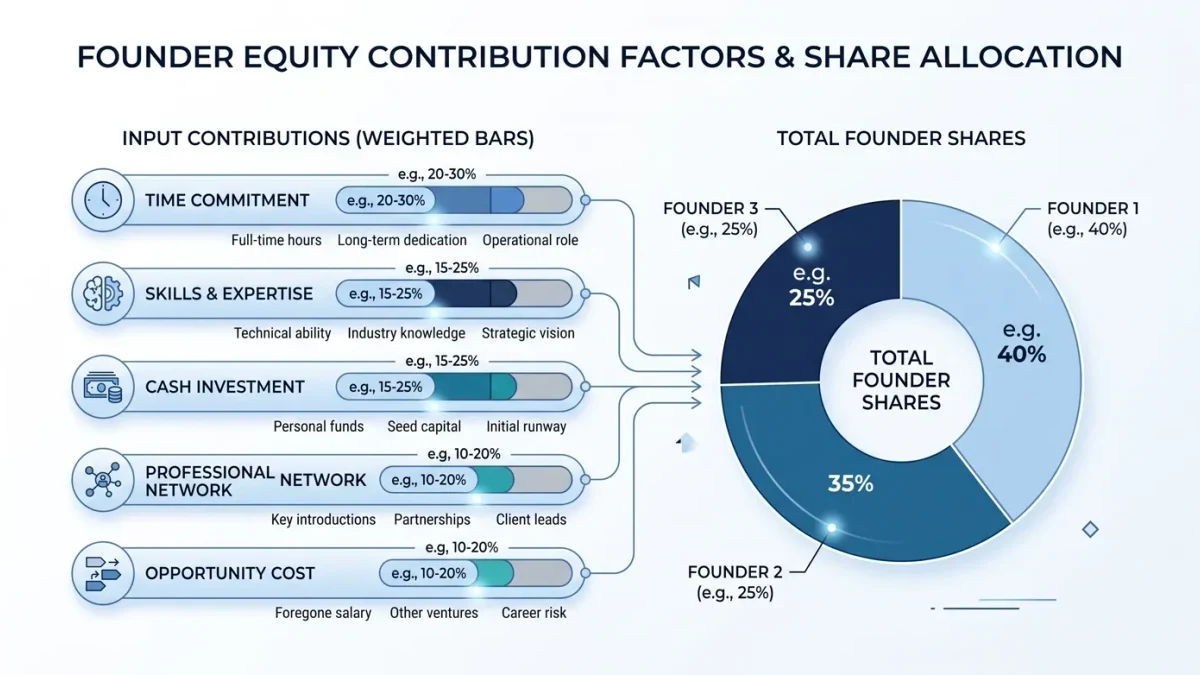
A practical method scores each founder across weighted factors before negotiating percentages:
- Idea and inception — who originated the concept and early work.
- Cash contributed — actual dollars, valued at face.
- Time commitment — full-time versus part-time, and for how long each founder has committed.
- Skills and scarcity — technical ability, sales capability, domain access.
- Network and distribution — customers, investors, or partners the founder brings.
- Opportunity cost — salary or status the founder is giving up.
Scoring converts a loaded negotiation into a comparison of numbers with reasons attached. It does not force precision — founders can round — it forces honesty about assumptions, which is what prevents the resentment.
What About Dynamic Equity and Milestone Models?
For teams whose future contributions are genuinely unpredictable, dynamic split models allocate equity as contributions accrue, using each founder's logged cash and time valued at market rates. The best-known formalization is the Slicing Pie framework; the concept predates any brand — book each contribution, convert to a stake when the picture stabilizes. The tradeoff is administrative weight and investor unfamiliarity: most venture-backed companies converge to fixed percentages plus vesting before a priced round. Dynamic methods suit bootstrapped teams of two to four with lumpy, uncertain contributions more than they suit startups on a fundraising clock.
What Else Must the Split Decision Include?
Three companions make any percentage livable. First, vesting for all founders — four years with a one-year cliff — so a departure does not strand a large stake off the cap table. Second, an employee option pool, commonly 10 to 15 percent created at the first priced round, so early hires can be compensated without reopening founder percentages. Third, written decision rights, because governance and economics are different questions: a 60/40 split does not automatically mean 60/40 voting, and small minority holders often hold veto rights over defined major decisions by contract. Percentages say who profits; governance says who decides.
When Is Equal Actually Right?
Genuinely symmetric teams — same cash in, both full time from the same date, complementary skills both view as equal, equal risk tolerance — split 50/50 sensibly, and many great companies started that way. The test is whether each founder would accept the other side of the trade. If either founder hesitates at that question, the hesitation itself is the argument for a scorecard conversation now rather than a renegotiation later.
The lesson: the split that survives is not the one that avoided the awkward week — it is the one that priced the awkward questions at the start, in writing, with vesting to back it.