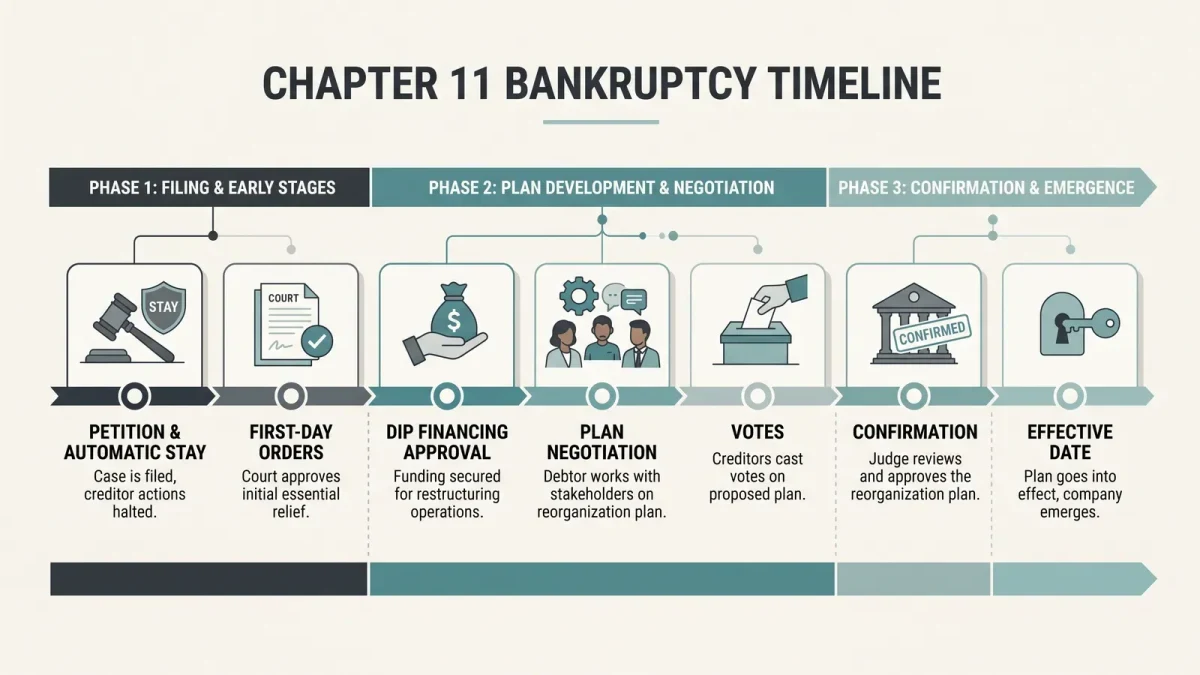
Chapter 11 of the U.S. Bankruptcy Code lets a company keep operating while it restructures its debts under court supervision: an automatic stay freezes collections the moment the petition is filed, the business becomes a debtor in possession running its own estate, new financing raised as debtor-in-possession (DIP) funding pays the bills, and creditors vote on a plan of reorganization that a judge confirms only if it is feasible and fair. It is the mechanism behind most major corporate restructurings in the news, and its logic — trading debt for equity or time under a referee — explains what those headlines actually mean. This article walks the process stage by stage.
What Happens on Day One?
Filing triggers the automatic stay: creditors cannot sue, collect, repossess, or even call about pre-filing debt without court permission. Management typically remains in place as debtor in possession — a deliberate feature of U.S. law, on the theory that incumbent operators preserve value better than an outside trustee — though lenders increasingly negotiate conditions, including chief restructuring officers or board changes, into their DIP financing. The company must file schedules of assets and liabilities, a statement of financial affairs, and monthly operating reports thereafter. The U.S. Trustee appoints a committee of unsecured creditors to represent the general creditor body, and from that point every material decision — selling assets, paying critical vendors, retaining professionals — runs through motions and notice.
What Is DIP Financing and Why Does It Control the Case?
Companies enter Chapter 11 short of cash, and post-petition operating money comes as DIP financing — loans that by statute take priority over most pre-bankruptcy debt and require court approval. DIP lenders hold real leverage: their covenants set budgets, deadlines, and sometimes milestones for selling the company or filing a plan, which is why DIP terms often shape outcomes more than the bankruptcy code itself. In many retail and healthcare cases, the pre-petition lenders themselves become the DIP lenders, rolling their exposure up the priority ladder — a structure critics note gives incumbent lenders both the money and the steering wheel.
How Does the Plan Get Done?
The endgame is a plan of reorganization: a contract among the company and its creditor classes that reduces debt, alters payment terms, or converts debt to equity, leaving a going concern. The absolute priority rule governs negotiation — classes of creditors are paid in order of seniority, and a junior class cannot be paid while a senior class objects and goes unpaid — which is why secured lenders negotiate first and equity holders usually end up diluted or cancelled. Classes vote on the plan; it is confirmed with required majorities, or crammed down on dissenting classes if statutory fairness tests are met; and once effective, discharged debts bind creditors permanently. The alternative endgame is conversion to Chapter 7 liquidation or a sale of the business as a going concern under section 363, common when no consensual plan is reachable — 363 sales move whole companies in weeks, often to credit-bid lenders.
What Do Small Businesses See in the News?
Headline reading becomes mechanical with the vocabulary: "DIP financing of $X" means the company has runway and a lender steering; "363 sale" means the business will be sold, not reorganized; "cramdown" means a judge imposed a plan over objectors; "subchapter V" marks the streamlined small-business track — debts under roughly $7.5 million, no creditors' committee by default, faster timelines — designed for exactly the Main Street cases the full process would swallow. For small-business owners, the practical points are earlier than the filing: Chapter 11 exists to preserve going-concern value, it is expensive (professional fees consume small cases), and the best outcomes historically come from filing with a credible plan and committed financing rather than as a last gasp. The lesson: Chapter 11 is neither failure nor rescue — it is a negotiated pause with a referee, whose value depends entirely on what the business brings into the room.