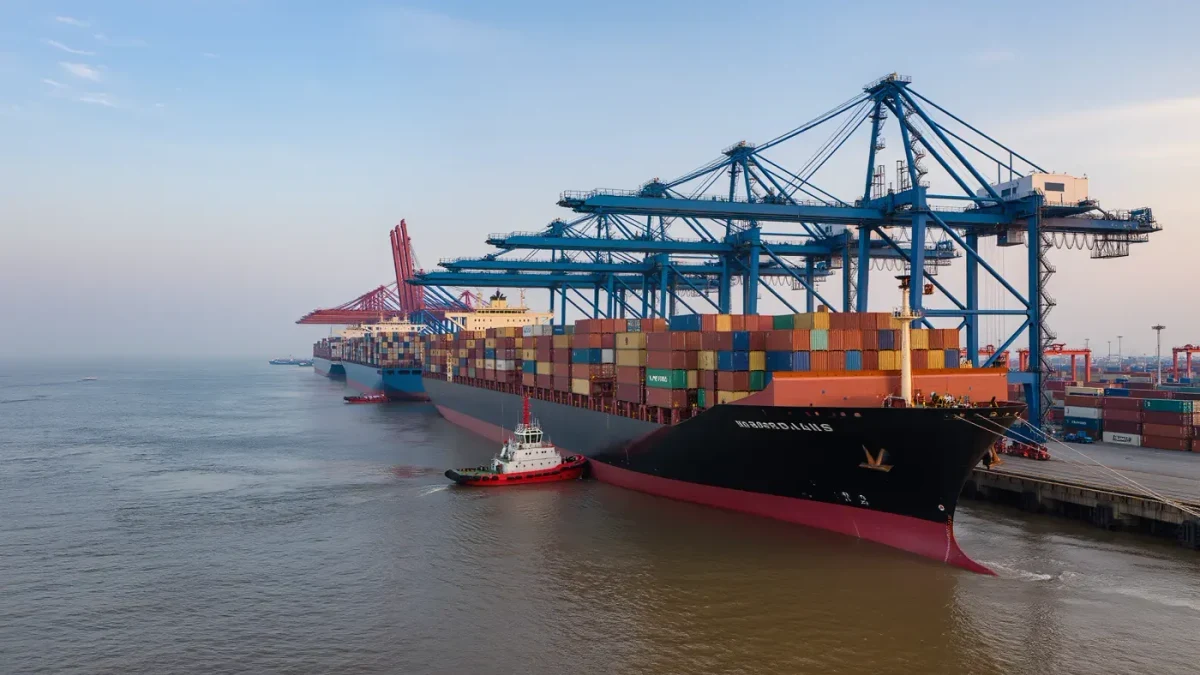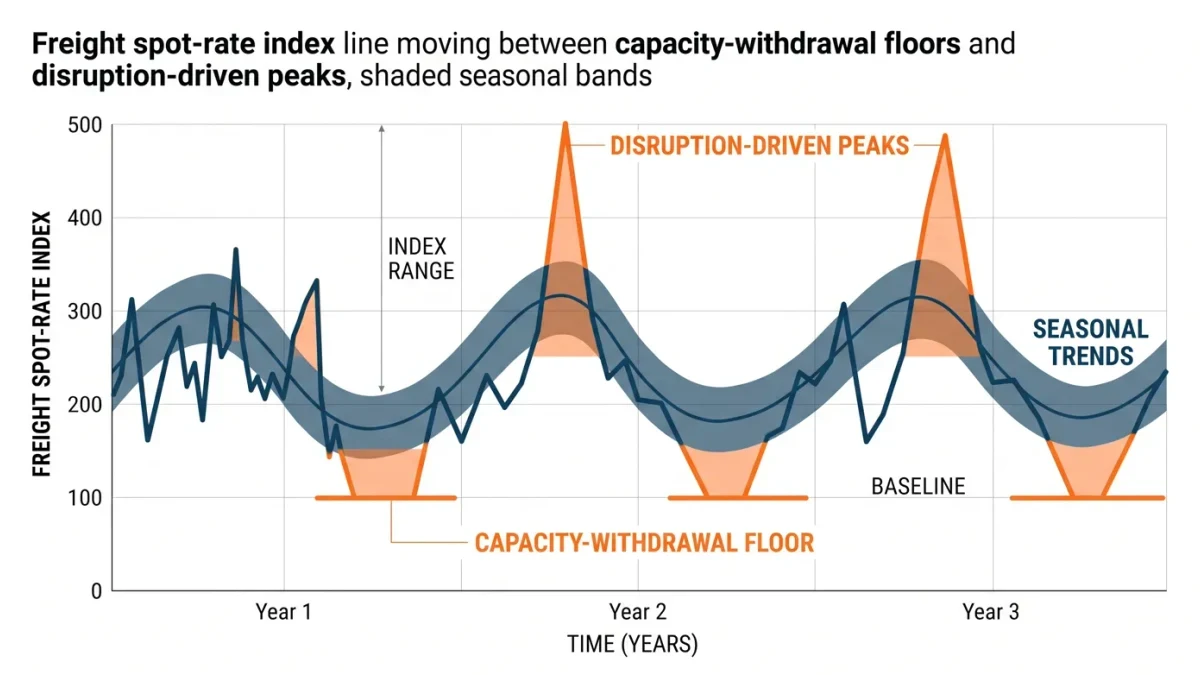
Ocean freight rates swing because capacity, demand, and disruptions move on separate clocks: carriers add or idle ships in response to profitability, consumers and businesses shift import volumes with inventories and seasons, and single events — a canal blockage, a war rerouting vessels, a port strike — remove capacity overnight. The results are visible in the indices: spot rates on major east-west trades have, within the past several years, risen several-fold above pre-pandemic baselines during disruptions and fallen back toward operating-cost levels when capacity returned, with the Freightos Baltic Index and Drewry's World Container Index publishing the moves weekly. For small importers and exporters, the practical task is not forecasting the market but understanding which of its three clocks is doing the moving before signing a rate. This article explains the mechanics.
Business News 7 publishes information, not logistics advice; rate strategy depends on volumes, lanes, and service needs.
How Does Capacity Discipline Work?
Container shipping is a commodity with fixed short-term supply: ships take years to build, so capacity cannot chase a demand spike quickly — but it can be idled quickly when demand falls, through blanked sailings in which carriers simply skip port calls or suspend strings. When rates fall toward carriers' operating costs, alliances idle capacity until supply and demand rebalance; when rates spike, every available ship, including aged tonnage, returns to service and new orders accelerate. Carriers also manage capacity through alliances and vessel-sharing agreements on the major lanes, which lets them adjust offered slots without moving whole fleets. For shippers, the observable consequence is cyclicality: periods of cheap freight with abundant space followed by periods of scarce space and premium rates, often within eighteen months of each other.
What Does Demand Seasonality Add?
Import demand runs a seasonal cycle — the pre-holiday build from summer through early fall, a post-holiday trough, and secondary rhythms around lunar new year factory shutdowns in Asia, which pull shipments earlier and then quiet the lanes. On top of the seasonal cycle sits the inventory cycle: when businesses restock aggressively, demand for containers rises with it, and when they destock — as in the post-pandemic inventory correction — container demand falls even while consumer spending holds. Small shippers experience the seasonality directly as space crunches and surcharges in peak weeks, and indirectly as the annual contract-negotiation window, when large shippers fix rates for the year ahead against the market's mood.
What Do Disruptions Do?
Disruptions remove capacity instantly and geographically: the 2021 Suez blockage held hundreds of ships and their slots hostage for six days with after-effects lasting months; security incidents in the Red Sea from late 2023 rerouted Asia-Europe traffic around the Cape of Good Hope, adding roughly ten to fourteen days per sailing and absorbing a meaningful share of global capacity; port congestion and strikes strand capacity that technically exists but cannot turn. Because disruptions hit a market already balanced tightly, their price effects dwarf the underlying economics — emergency surcharges, premium products for guaranteed space, and spot rates that detach from contract rates until the disruption clears. The pattern repeats often enough that shippers can plan for the class of event even when the specific event is unknowable.
How Should a Small Shipper Respond?
Four practices hold up in every regime. Quote both ways — spot versus contract — when volume justifies, fixing rates for a base volume and leaving spikes to the spot market. Build the disruption buffer into lead times and safety stock for critical inputs rather than budgeting for perfect reliability. Watch one or two published indices weekly rather than reacting to every forwarder email, since rate offers trail the indices by days. And diversify routing options modestly — alternate ports of loading or discharge, or intermodal combinations — so a single lane's crisis is a reroute rather than a stoppage. The lesson: the freight market pays shippers who understand which clock is moving — capacity, season, or disruption — and punishes those who renew on autopilot.