The commercial lease terms that most affect a small tenant's total cost are the escalation schedule, the pass-through expense structure, personal guarantee terms, the tenant improvement allowance, and the renewal and exit options — and every one of them is negotiable in ways the quoted base rent is not. Landlords typically present their standard form; tenants who negotiate specific clauses routinely save five figures over a lease term. Because a lease is often a small business's largest multi-year commitment after payroll, the clauses deserve line-by-line attention before signature. This article covers the ones that move real money.
What Are You Actually Paying Under NNN?
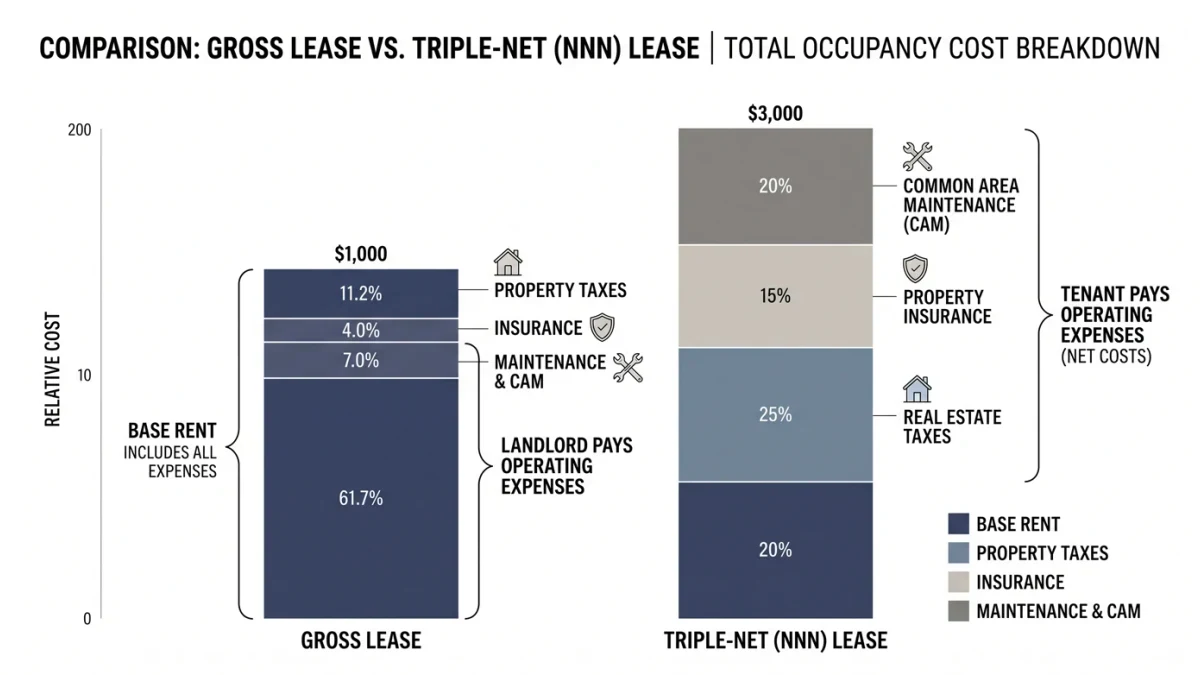
Commercial leases come in three broad structures. Gross leases fold building costs into one rent. Modified gross leases pass through defined expenses. Triple-net (NNN) leases charge base rent plus the tenant's share of property taxes, insurance, and common-area maintenance — the structure most small retail and industrial tenants encounter. The practical consequence: an NNN quote of $24 per square foot plus $8 in pass-throughs is a $32 space, and the pass-throughs can rise without cap. Two clauses tame them: a cap on annual increases in controllable operating expenses, and audit rights over the landlord's expense allocations. Uncapped CAM charges are among the most common post-signing surprises tenants report.
Why Do Escalations Compound So Heavily?
Multi-year leases fix annual rent increases in advance — commonly 2 to 4 percent per year, or fixed steps. Over five years, 3 percent annual escalations raise rent about 16 percent cumulatively, a number tenants often accept without modeling. Negotiable alternatives include smaller fixed steps in early years matching the business's ramp, escalations tied to a published index with a ceiling, or abatement periods — free-rent months — that offset the compounding. The total-occupancy-cost view matters more than any single year: tenants should model the full term, including pass-through growth, before comparing spaces.
What Should the Personal Guarantee Clause Say?
Small tenants are usually asked to personally guarantee the lease, making the owner liable for the full term's rent if the business fails. The clause is negotiable even when the guarantee itself is not: burn-off provisions release the guarantor after a period of on-time payment; caps limit exposure to a defined number of months' rent; and good-guy clauses — standard in some markets — limit the guarantee to a shorter period provided the tenant surrenders the space clean and current. A guarantee with a twelve-month cap and a two-year burn-off is a materially different document from an uncapped full-term guarantee, and landlords do accept the difference for creditworthy tenants.
What Are the TI Allowance and Renewal Options Worth?
Tenant improvement (TI) money — the landlord's contribution to build-out — is quoted per square foot and directly reduces the tenant's opening cost; even modest TI dollars can exceed a year of negotiated rent savings, so it belongs in the same negotiation as price. On the back end, the renewal option sets the rules for staying: tenants should seek an option to renew at defined terms (either stated rent or fair market value with arbitration), a right of first refusal on adjacent space, and — critically — assignment and sublet rights, because selling or relocating the business later runs through them. Exit terms cut the other way: early-termination provisions with a defined penalty give the business a floor on its downside that pure term commitment does not.
How Should a Tenant Approach the Negotiation?
Sequence matters. Establish total occupancy cost under each structure before comparing quotes; negotiate the term length and escalations as one package with TI and abatement; then tighten guarantee and exit clauses with specifics, not general complaints. Every concession trades — landlords move on TI and abatement when the term is longer, on rent when the space has sat vacant. Tenants who arrive with a modeled total cost and a credible alternative space consistently negotiate better than those who argue single lines. The lesson: the quoted rent is the opening position, not the deal — the structure is the deal.