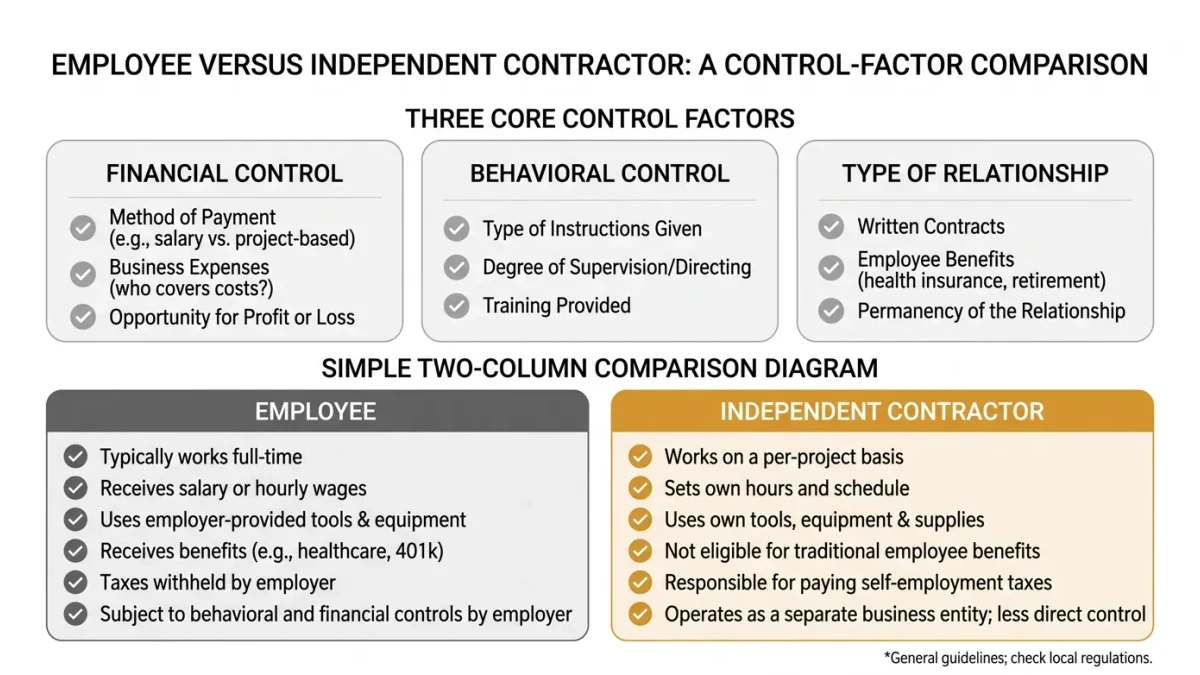
Worker classification turns on control: the IRS examines behavioral control, financial control, and the relationship's overall shape to decide whether a worker is an employee or an independent contractor, and a contract calling someone a contractor does not decide the question. The stakes are concrete — misclassified employers can owe back employment taxes, plus penalties and interest, for every affected pay period, and Department of Labor rules add minimum-wage and overtime exposure on top. This article explains the tests small businesses actually need.
What Are the Common-Law Control Factors?
The IRS common-law test groups the evidence into three families. Behavioral control: does the business instruct how, when, and where the work is done, with what tools and training? Instruction of method points toward employee status; a worker who controls their own process points toward contractor. Financial control: does the worker have unreimbursed expenses, an investment in their own equipment, the ability to work for other clients, and pricing set by the job rather than by the hour under the business's payroll? Contractors run their own economics. Relationship type: written contracts, benefits, permanence, and whether the work is a key part of the business's regular activity all point along the spectrum. No single factor decides; the totality does, and a genuine contractor relationship shows it across all three families.
What Are the Practical Differences for the Business?
| Obligation | Employee | Contractor |
|---|---|---|
| Payroll taxes (FICA) | Employer withholds and matches | Worker pays self-employment tax |
| Unemployment insurance | Required | Not required |
| Workers' compensation | Required by most states | Generally not required |
| Benefits, leave | Often apply | Not offered |
| Minimum wage / overtime (FLSA) | Applies | Does not, if properly classified |
The cost difference is why misclassification is tempting and why enforcement is persistent: the savings are real until an audit, a state unemployment claim, or a worker's complaint reopens every pay period at once.
What Happens if the IRS Finds Misclassification?
The employer can be assessed the employment taxes that should have been withheld, plus accuracy-related penalties and interest, for the lookback period — and if the worker also failed to pay income tax, the exposure compounds. Section 530 relief can protect a business that filed required Forms 1099 consistently, treated the worker as a contractor, and had a reasonable basis for the classification, such as industry practice or prior audit treatment; the protection is valuable precisely because it rewards documentation kept all along rather than arguments assembled later. Separately, the Department of Labor enforces FSA classification for wage-and-hour purposes under its own economic-reality analysis, so passing one agency's test does not settle the others.
How Should a Small Business Decide Safely?
A short checklist prevents most problems. Define the role before hiring: if it needs set hours, your tools, your training, and ongoing direction, it is an employee role regardless of how the payroll is labeled. For genuine contractors, put the scope, deliverables, and independence in writing; require invoicing; file Form 1099-NEC for payments of $600 or more; and let the worker serve other clients without friction. Re-examine long-term "contractors" annually — relationships drift toward dependence in both directions, and the facts of year three, not year one, control the answer. When the role sits in the gray middle, a written determination from a tax professional or the IRS itself costs far less than a multi-year correction.
The lesson: classification is a facts test about control, applied retroactively — structure the role honestly from the start, document it, and the label takes care of itself.