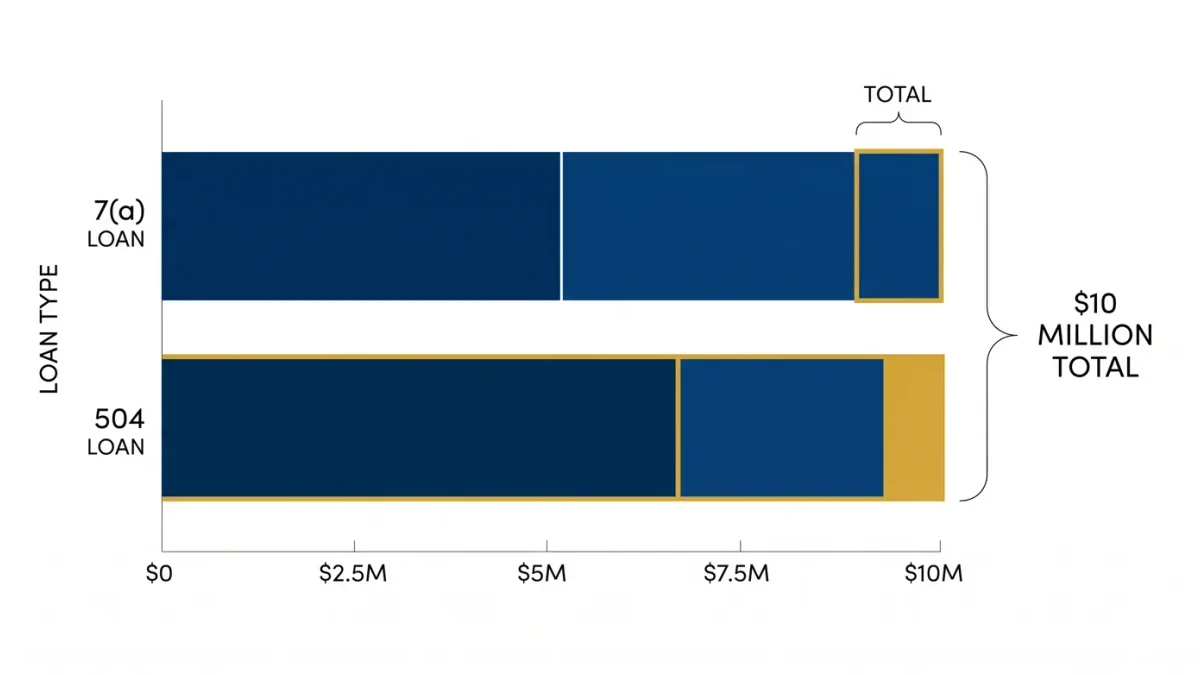
Small businesses can now combine up to $10 million in SBA-backed financing — $5 million through a 7(a) loan plus $5 million through a 504 loan — under a policy the U.S. Small Business Administration announced July 7, 2026, doubling the previous $5 million cumulative cap in what the agency calls the largest maximum financing in its history. The change took effect July 4, 2026, per the agency's news release 26-69, and applies to borrowers who secure the 7(a) loan first.
What Exactly Changed?
Before the revision, SBA borrowers faced a $5 million cumulative cap across the agency's main loan programs, which forced capital-intensive businesses to choose between funding streams: the 7(a) program, which covers working capital, equipment, real estate, and expansion, or the 504 program, which provides long-term fixed-rate financing for major fixed assets through Certified Development Companies. The new policy decouples 7(a) balances from the 504 program, so a business can pair long-term real estate or equipment financing with the working capital needed to actually run the expanded operation. Small manufacturers, who per the agency can take unlimited 504 loans as long as each funds a distinct project, are also newly eligible for $5 million under 7(a).
What Does It Change for Owners?
For owners planning a facility purchase, a production-line expansion, or a buyout that needs both a building and cash to operate it, the change removes a sequencing trap: previously, using the full 7(a) cap left no room under the combined limit for the fixed-asset side. The practical path now is a two-loan structure — 7(a) first, then 504 — sized to the full $10 million. The announcement builds on a policy change the agency says it first announced in May 2026, and it arrives as the FY2026 appropriations process has included proposals to reduce SBA funding, per the Congressional Research Service, making the expanded lending authority a notable counter-signal for borrowers watching the agency's direction.
Who Qualifies?
Standard SBA eligibility still governs: the business must meet the agency's size standards, demonstrate repayment ability, and apply through an SBA-approved lender for 7(a) or a Certified Development Company for 504. The combined $10 million requires the 7(a) loan to be secured first — a sequencing condition owners should build into their financing timeline from the start. Borrowers already carrying 7(a) balances should ask their lender how the decoupling applies to their situation before assuming headroom exists.
The takeaway for owners: the ceiling on federally backed small-business financing just doubled, but only for those who structure the loans in the right order — plan the 7(a) first, and the 504 can follow.