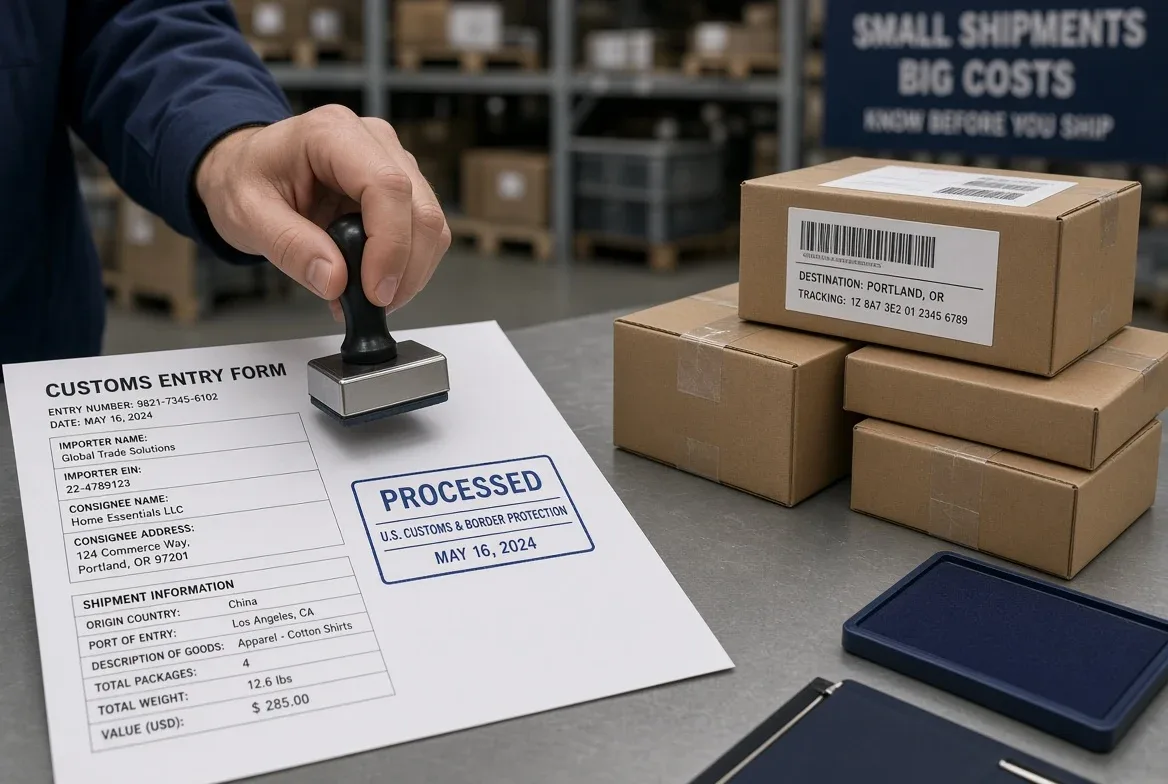
The de minimis exemption that let shipments worth $800 or less enter the United States duty-free without a formal customs filing is gone for nearly every import channel. Under a Customs and Border Protection rule that took effect June 24, 2026, most low-value shipments now require a formal or informal entry, with duties, taxes, and fees paid up front — a real cost and paperwork change for small importers who built their pricing around free entry.
What Was the De Minimis Exemption?
Formally known as Section 321, the exemption let U.S. Customs and Border Protection waive duties and formal paperwork on shipments valued at $800 or less imported by one person on one day, as CBP's own import-export guidance describes it. The Federal Register notice implementing the current suspension explains the original logic: the provision existed to "avoid expense and inconvenience to the Government disproportionate to the amount of revenue that would otherwise be collected." In practice, that meant a small business ordering a $600 batch of components, or a solo seller shipping direct-to-consumer packages under $800, paid no duty and filed no formal entry.
CBP notes that two test programs had been used to monitor the flood of e-commerce shipments moving through the exemption, reflecting how much low-value, direct-to-consumer trade had come to rely on it. That volume is exactly what made the exemption a target for policymakers: a rule designed to spare the government the cost of collecting small amounts of duty had, over time, become the default entry path for a large share of parcels shipped directly to American consumers, rather than the narrow exception it was written for.
What Changed, and When?
A CBP interim final rule published in the Federal Register put an indefinite suspension of the de minimis exemption into effect on June 24, 2026, for merchandise arriving through every transportation mode except the international postal network. The rule states plainly that "all entries of merchandise valued at $800 or less arriving through all modes other than the international postal network must utilize formal or informal entry procedures." That covers express carriers, air cargo, ocean freight, and truck shipments — the channels most small importers and e-commerce sellers actually use.
Because it is an interim final rule, the suspension is already in force, but CBP left the public comment period open through July 24, 2026, meaning the specific procedures could still be adjusted before they're locked in permanently.
What Does a Small Importer Have to Do Now?
A shipment that once cleared customs automatically now has to go through standard informal entry (Entry Type 11) or formal entry, per the Federal Register notice, which means submitting complete entry data and paying whatever duties, taxes, and fees apply — costs that were previously waived outright. For a small business, that translates into three practical changes:
- Every qualifying shipment needs entry paperwork filed, not just a customs declaration.
- Duties and processing fees that used to be zero are now a real line item, which changes landed cost and margin.
- Many small importers who never needed one will now rely on a licensed customs broker to file entries correctly, adding a service cost on top of the duty itself.
Mail shipments through the international postal network are the one carve-out named in the rule, though CBP's notice does not promise that exception is permanent.
Does This Change Affect Businesses That Sell Abroad, Too?
Indirectly, yes — but the relevant threshold for a U.S. small business shipping products to a customer overseas isn't the U.S. rule at all. It's the destination country's own de minimis threshold, and those vary widely. The International Trade Administration's guidance on de minimis value lists Canada's threshold at roughly USD 20, Europe's at around USD 190, and Australia's at USD 1,000, with some markets set as low as USD 5. A U.S. seller exporting to Canada, in other words, loses the duty-free break almost immediately, while a shipment to Australia has much more room. The ITA's guidance frames this as a pricing issue: knowing the buyer's country threshold lets a seller quote an accurate landed cost — goods, freight, insurance, and any duty — before the sale closes, rather than surprising the customer at delivery.
| Destination | Approximate de minimis threshold (USD) |
|---|---|
| Australia | 1,000 |
| Europe (varies by country) | ~190 |
| Canada | 20 |
| Some other markets | as low as 5 |
Those numbers come from the International Trade Administration's own guidance, which also directs exporters to the Global Express Association's country-by-country database for the exact figure in any given market, since thresholds change and vary further by product category in some countries.
What Should a Small Importer Do Now?
- Check whether incoming shipments arrive by mail (still exempt for now) or by carrier/freight (now subject to entry procedures), per the Federal Register rule.
- Get a landed-cost estimate that includes duties and entry fees, not the old duty-free assumption.
- Talk to a licensed customs broker if filing volume or complexity makes in-house entry impractical.
- Watch the CBP comment period, open through July 24, 2026, for any changes to how the rule is implemented.
The exemption that quietly underwrote a decade of low-value cross-border e-commerce is, for now, mostly gone. The businesses that adjust their pricing and paperwork first will be the ones least surprised by the invoice.
For a related small business perspective, read What an SBA 7(a) Loan Really Costs Small Business Owners.