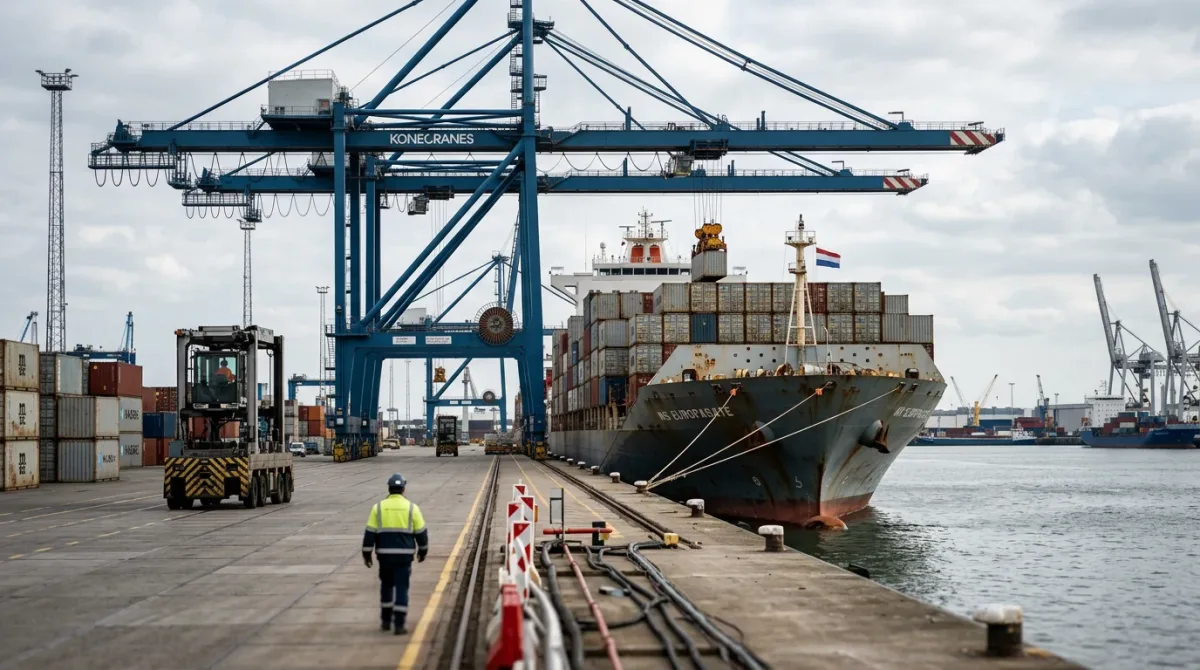
The European Union started charging for carbon embedded in imported goods on 1 January 2026, per the European Commission's Taxation and Customs Union. Importers above a 50-tonne annual threshold must hold authorised declarant status, report embedded emissions and surrender certificates. Six sectors are covered, and no certificates are sold before February 2027.
What is the carbon border adjustment mechanism?
The carbon border adjustment mechanism, or CBAM, is an import charge that prices the greenhouse gases embedded in selected goods at the level the EU's own emissions trading system charges domestic producers. Regulation (EU) 2023/956 states in Article 1(1) that it addresses emissions embedded in the goods listed in Annex I "in order to prevent the risk of carbon leakage."
Carbon leakage is the outcome the instrument is built against. Recital 9 of the same regulation defines it as the case where, for reasons of costs related to climate policies, businesses transfer production to other countries or imports from those countries replace equivalent products.
Article 2(1) limits the scope to Annex I goods originating in a third country and imported into the EU customs territory. The Commission lists those goods as cement, iron and steel, aluminium, fertilisers, electricity and hydrogen.
What changed on 1 January 2026?
The obligation changed from reporting to paying. The Commission's transitional phase ran from 2023 to 2025 and required data only; the definitive regime that took effect on 1 January 2026 adds authorisation, annual declaration of embedded emissions, and purchase and surrender of CBAM certificates.
| Phase | Dates | What importers must do | Financial obligation |
|---|---|---|---|
| Transitional | 1 October 2023 to 31 December 2025 | Quarterly reports on embedded emissions; last report due 31 January 2026 | None |
| Definitive | From 1 January 2026 | Authorised CBAM declarant status; annual declaration of embedded emissions; surrender of certificates | Purchase and surrender of CBAM certificates |
The deadline for the final transitional report, 31 January 2026, comes from Regulation (EU) 2023/956. The phase dates and the definitive-regime duties come from the Commission's CBAM pages.
How is the charge actually calculated?
The Commission describes a sequence rather than a tariff rate. There is no percentage schedule; the amount owed follows from measured emissions and an allowance price set elsewhere.
- The declarant establishes the emissions embedded in each consignment of covered goods.
- Those emissions are converted into a number of CBAM certificates.
- The certificate price is derived from EU emissions trading system allowance auction prices: a quarterly average during 2026, moving to a weekly average from 2027, per the Commission.
- Where a carbon price has already been paid during production of the imported goods, the Commission states that the corresponding amount can be deducted.
- Ireland's Environmental Protection Agency, one of the national competent authorities, adds that the calculation also nets off EU ETS free allocation.
The analysis: the deduction step is what separates CBAM from a conventional tariff in the sourced design — the charge falls only on the gap between the exporter's carbon cost and the EU's. The Commission's own December 2025 report notes some 80 carbon pricing instruments operating in 95 jurisdictions in 2025, covering about 28% of global greenhouse gas emissions, which is the pool from which such deductions can be claimed. What would change this reading is the implementing act on deducting third-country carbon prices, which the Commission lists as still to come.
Who has to register, and by when?
Only importers above the threshold. The European Parliament, adopting its position on 21 May 2025 by 564 votes to 20 with 12 abstentions, described a 50-tonne annual de minimis threshold that exempts roughly 90% of importers, mostly small firms and occasional importers, while leaving 99% of CO2 emissions from iron, steel, aluminium, cement and fertiliser imports inside the system.
Ireland's Environmental Protection Agency, acting as national competent authority, gives 31 March 2026 as the authorisation deadline for importers that intend to keep importing covered goods. The Commission's December 2025 report states that certificate trading begins on 1 February 2027, so the 2026 obligation accrues before any certificate can be bought.
The sources do not agree on the first declaration deadline. Regulation (EU) 2023/956 as adopted states in recital 45 that the first CBAM declaration, for calendar year 2026, should be submitted by 31 May 2027. Ireland's Environmental Protection Agency describes purchase and surrender by 30 September each year. The 2025 simplification package amended the regulation's timetable; on the evidence used here the first-cycle date is unsettled.
Who outside the EU does this reach?
Less trade than the instrument's profile suggests. An OECD analysis published on 16 March 2025 finds that covered goods account for around 3% of EU imports from non-EU countries, and that the covered sectors represent 7.0% of EU manufacturing production, 2.3% of total gross output, 1.1% of value added and 0.6% of employment in the EU.
The volumes are still large in absolute terms. The Commission's December 2025 report records roughly 156 million tonnes of CBAM goods imported between the fourth quarter of 2023 and the second quarter of 2025, with 167 million tonnes of CO2-equivalent embedded emissions in 2024. The same report puts the effect on least-developed countries' GDP by 2035 at less than 0.01%.
The analysis: the OECD framing and the Commission framing are answering different questions rather than contradicting each other — one measures the share of trade touched, the other the tonnage and the development impact. Read together, the sourced record describes a narrow instrument with concentrated exposure in a few metal and mineral supply chains. What would change the reading is the scope extension the Commission has proposed, which would widen the covered product list beyond the current six sectors.
What comes next?
Extension, in two steps. In its report of 16 December 2025, the Commission set out a first step for 2026 and 2027 covering selected steel- and aluminium-intensive downstream products, strengthened anti-circumvention rules, amended electricity emission calculation rules, and an implementing act on deducting carbon prices paid in third countries.
A second step from 2027 would extend to indirect emissions from further goods and potentially to other sectors under the EU emissions trading system. The European Parliament's May 2025 press release states that the Commission would assess extending CBAM scope to other ETS sectors in early 2026.
Compliance data from the transitional phase sits behind that sequencing. The Commission reports that 95% of importers bringing in more than 50 tonnes of CBAM goods a year were reporting actual embedded emissions by the third quarter of 2025, against 11% in the third quarter of 2023.
The analysis: the reporting shift from default values to actual emissions is the part of the record that most directly supports extension, because a wider product list only works if suppliers can produce verifiable installation-level data. The proposals are legislative texts that have not completed passage; nothing in the sourced record fixes their final scope or timing.
For a related economy news perspective, read A Unique Platform for Independent Writers.
For more context, read How Tariffs Work And Who Actually Pays Them.